Leben in Deutschland test: questions 201–250 with answers
Questions 201 to 250 of the 300 general questions in the official catalogue, in catalogue order. Answer first, then reveal the correct answer, the English translation and an explanation. The practice tool covers all 310 questions and a 33-question mock test.
The test in brief
- 33 questions: 30 general questions and 3 questions about your federal state. Time: 60 minutes.
- Each question has four options and exactly one correct answer.
- For citizenship you need at least 17 correct answers.
- In the „Leben in Deutschland“ test of the integration course, 15 correct answers are enough for the certificate; 17 or more also count for a citizenship application.
Registration, fee, test centres and exemptions: our Leben in Deutschland test guide
Where do the questions and answers come from?
The German wording of the questions and options is taken unchanged from the official catalogue: Annex 1 of the Citizenship Test Ordinance (Einbürgerungstestverordnung). For the 5 questions whose content BAMF updated in its catalogue of 7 May 2025 (for example the question on the current chancellor) we use BAMF's wording. The images also come from the ordinance.
The catalogue does not mark the correct answers. We built the answer key from two independent solutions and then checked it against the answers in BAMF's online catalogue. The English translations and explanations are by Level Exams; in the test itself the questions are asked in German only.
Questions whose answer changes over time (the current chancellor, the parliamentary groups, population and similar) are marked and show the situation in November 2026. Level Exams is not affiliated with BAMF, telc gGmbH, ÖSD or the Goethe-Institut.
All 300 general questions with answers
The questions follow the order of the official catalogue. Answer first, then press „Show answer“ to see the correct option, an English translation and an explanation.
Questions 201–250
Question 201
Welche der folgenden Auflistungen enthält nur Bundesländer, die zum Gebiet der früheren DDR gehörten?
- a)Niedersachsen, Nordrhein-Westfalen, Hessen, Schleswig-Holstein, Brandenburg
- b)Mecklenburg-Vorpommern, Brandenburg, Sachsen, Sachsen-Anhalt, Thüringen
- c)Bayern, Baden-Württemberg, Rheinland-Pfalz, Thüringen, Sachsen
- d)Sachsen, Thüringen, Hessen, Niedersachsen, Brandenburg
›Show answer
Correct answer: b) Mecklenburg-Vorpommern, Brandenburg, Sachsen, Sachsen-Anhalt, Thüringen
In English
Which of the following lists contains only federal states that belonged to the territory of the former GDR?
- a) Lower Saxony (Niedersachsen), North Rhine-Westphalia (Nordrhein-Westfalen), Hesse (Hessen), Schleswig-Holstein, Brandenburg
- b) Mecklenburg-Western Pomerania (Mecklenburg-Vorpommern), Brandenburg, Saxony (Sachsen), Saxony-Anhalt (Sachsen-Anhalt), Thuringia (Thüringen)
- c) Bavaria (Bayern), Baden-Württemberg, Rhineland-Palatinate (Rheinland-Pfalz), Thuringia (Thüringen), Saxony (Sachsen)
- d) Saxony (Sachsen), Thuringia (Thüringen), Hesse (Hessen), Lower Saxony (Niedersachsen), Brandenburg
Explanation: The five states on the territory of the former GDR are Mecklenburg-Western Pomerania, Brandenburg, Saxony, Saxony-Anhalt and Thuringia, and only this list contains just them. The other lists also include western states such as Lower Saxony, Hesse or Bavaria.
Question 202
Zu wem gehörte die DDR im „Kalten Krieg“?
- a)zu den Westmächten
- b)zum Warschauer Pakt
- c)zur NATO
- d)zu den blockfreien Staaten
›Show answer
Correct answer: b) zum Warschauer Pakt
In English
Which side did the GDR belong to in the ‘Cold War’?
- a) to the Western powers
- b) to the Warsaw Pact
- c) to NATO
- d) to the non-aligned states
Explanation: During the Cold War the GDR belonged to the Soviet-led Eastern Bloc and its military alliance, the Warsaw Pact. The Federal Republic, by contrast, was on the Western side as a member of NATO.
Question 203
Wie hieß das Wirtschaftssystem der DDR?
- a)Marktwirtschaft
- b)Planwirtschaft
- c)Angebot und Nachfrage
- d)Kapitalismus
›Show answer
Correct answer: b) Planwirtschaft
In English
What was the economic system of the GDR called?
- a) Market economy
- b) Planned economy
- c) Supply and demand
- d) Capitalism
Explanation: The GDR had a planned economy (Planwirtschaft): production and prices were set by state plans rather than by the market. The Federal Republic, by contrast, has a social market economy.
Question 204
Wie wurden die Bundesrepublik Deutschland und die DDR zu einem Staat?
- a)Die Bundesrepublik Deutschland hat die DDR besetzt.
- b)Die heutigen fünf östlichen Bundesländer sind der Bundesrepublik Deutschland beigetreten.
- c)Die westlichen Bundesländer sind der DDR beigetreten.
- d)Die DDR hat die Bundesrepublik Deutschland besetzt.
›Show answer
Correct answer: b) Die heutigen fünf östlichen Bundesländer sind der Bundesrepublik Deutschland beigetreten.
In English
How did the Federal Republic of Germany and the GDR become one state?
- a) The Federal Republic of Germany occupied the GDR.
- b) Today's five eastern federal states joined the Federal Republic of Germany.
- c) The western federal states joined the GDR.
- d) The GDR occupied the Federal Republic of Germany.
Explanation: Reunification did not happen through occupation: on 3 October 1990 the five re-established eastern states joined the Federal Republic. The accession was based on the then Article 23 of the Basic Law and had been decided by the GDR's freely elected parliament.
Question 205
Mit dem Beitritt der DDR zur Bundesrepublik Deutschland gehören die neuen Bundesländer nun auch …
- a)zur Europäischen Union.
- b)zum Warschauer Pakt.
- c)zur OPEC.
- d)zur Europäischen Verteidigungsgemeinschaft.
›Show answer
Correct answer: a) zur Europäischen Union.
In English
With the accession of the GDR to the Federal Republic of Germany, the new federal states now also belong …
- a) to the European Union.
- b) to the Warsaw Pact.
- c) to OPEC.
- d) to the European Defence Community.
Explanation: The Federal Republic was a founding member of the European Communities, so with the GDR's accession the new states automatically became part of them as well. In 1990 this was still the European Community; today it is the European Union.
Question 206
Woran erinnern die sogenannten „Stolpersteine“ in Deutschland?
- a)an berühmte deutsche Politikerinnen und Politiker
- b)an die Opfer des Nationalsozialismus
- c)an Verkehrstote
- d)an bekannte jüdische Musiker
›Show answer
Correct answer: b) an die Opfer des Nationalsozialismus
In English
What do the so-called ‘stumbling stones’ (Stolpersteine) in Germany commemorate?
- a) famous German politicians
- b) the victims of National Socialism
- c) people killed in road accidents
- d) well-known Jewish musicians
Explanation: Stumbling stones are small brass plaques set into the pavement in front of the last freely chosen homes of people who were persecuted, deported or murdered under National Socialism. Each one bears the person's name and fate.
Question 207
In welchem Militärbündnis war die DDR Mitglied?
- a)in der NATO
- b)im Rheinbund
- c)im Warschauer Pakt
- d)im Europabündnis
›Show answer
Correct answer: c) im Warschauer Pakt
In English
Which military alliance was the GDR a member of?
- a) NATO
- b) the Confederation of the Rhine (Rheinbund)
- c) the Warsaw Pact
- d) the European Alliance (Europabündnis)
Explanation: The GDR was a member of the Warsaw Pact, the Soviet-led military alliance. NATO was the Western alliance, and the Confederation of the Rhine dates back to Napoleon's time.
Question 208
Was war die „Stasi“?
- a)der Geheimdienst im „Dritten Reich“
- b)eine berühmte deutsche Gedenkstätte
- c)der Geheimdienst der DDR
- d)ein deutscher Sportverein während des Zweiten Weltkrieges
›Show answer
Correct answer: c) der Geheimdienst der DDR
In English
What was the „Stasi“?
- a) the secret service in the ‘Third Reich’
- b) a famous German memorial site
- c) the secret service of the GDR
- d) a German sports club during the Second World War
Explanation: The „Stasi“ was the secret service of the GDR (Ministry for State Security); it monitored the population and persecuted opponents. The secret state police of the ‘Third Reich’ was the Gestapo.
Question 209
Welches war das Wappen der Deutschen Demokratischen Republik?
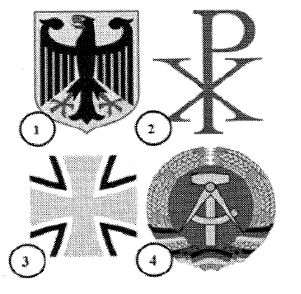
- a)1
- b)2
- c)3
- d)4
›Show answer
Correct answer: d) Option 4
In English
Which was the coat of arms of the German Democratic Republic?
Explanation: Image 4 shows the coat of arms of the GDR: a hammer and a pair of compasses surrounded by a wreath of grain wrapped in a black, red and gold ribbon. Image 1 is the coat of arms of today's Federal Republic (the federal eagle).
Question 210
Was ereignete sich am 17. Juni 1953 in der DDR?
- a)der feierliche Beitritt zum Warschauer Pakt
- b)landesweite Streiks und ein Volksaufstand
- c)der 1. SED-Parteitag
- d)der erste Besuch Fidel Castros
›Show answer
Correct answer: b) landesweite Streiks und ein Volksaufstand
In English
What happened in the GDR on 17 June 1953?
- a) the ceremonial accession to the Warsaw Pact
- b) nationwide strikes and a popular uprising
- c) the 1st SED party congress
- d) Fidel Castro's first visit
Explanation: On 17 June 1953 workers in the GDR went on strike, and the protests turned into a nationwide popular uprising. Soviet troops crushed it.
Question 211
Welcher Politiker steht für die „Ostverträge“?
- a)Helmut Kohl
- b)Willy Brandt
- c)Michail Gorbatschow
- d)Ludwig Erhard
›Show answer
Correct answer: b) Willy Brandt
In English
Which politician is associated with the ‘Eastern Treaties’ (Ostverträge)?
- a) Helmut Kohl
- b) Willy Brandt
- c) Mikhail Gorbachev
- d) Ludwig Erhard
Explanation: In the early 1970s Federal Chancellor Willy Brandt used the Eastern Treaties to improve relations with the Soviet Union, Poland and Czechoslovakia and to regulate relations with the GDR. This policy is known as the ‘new Ostpolitik’.
Question 212
Wie heißt Deutschland mit vollem Namen?
- a)Bundesstaat Deutschland
- b)Bundesländer Deutschland
- c)Bundesrepublik Deutschland
- d)Bundesbezirk Deutschland
›Show answer
Correct answer: c) Bundesrepublik Deutschland
In English
What is Germany's full name?
- a) Federal State of Germany (Bundesstaat Deutschland)
- b) Federal States of Germany (Bundesländer Deutschland)
- c) Federal Republic of Germany (Bundesrepublik Deutschland)
- d) Federal District of Germany (Bundesbezirk Deutschland)
Explanation: Germany's full name is the Federal Republic of Germany (Bundesrepublik Deutschland). The name shows that the country is both a federal state and a republic (Article 20 of the Basic Law).
Question 213
Wie viele Einwohner hat Deutschland?
- a)70 Millionen
- b)78 Millionen
- c)84 Millionen
- d)90 Millionen
›Show answer
Correct answer: c) 84 Millionen
In English
How many inhabitants does Germany have?
- a) 70 million
- b) 78 million
- c) 84 million
- d) 90 million
Explanation: About 84 million people live in Germany (as of November 2026), which makes it the most populous country in the European Union.
The answer to this question can change over time (situation in November 2026).
Question 214
Welche Farben hat die deutsche Flagge?
- a)schwarz-rot-gold
- b)rot-weiß-schwarz
- c)schwarz-rot-grün
- d)schwarz-gelb-rot
›Show answer
Correct answer: a) schwarz-rot-gold
In English
What colours does the German flag have?
- a) black-red-gold
- b) red-white-black
- c) black-red-green
- d) black-yellow-red
Explanation: According to Article 22 of the Basic Law, the federal flag is black, red and gold. These colours go back to the 19th-century movement for unity and freedom.
Question 215
Wer wird als „Kanzler der Deutschen Einheit“ bezeichnet?
- a)Gerhard Schröder
- b)Helmut Kohl
- c)Konrad Adenauer
- d)Helmut Schmidt
›Show answer
Correct answer: b) Helmut Kohl
In English
Who is known as the ‘Chancellor of German Unity’?
- a) Gerhard Schröder
- b) Helmut Kohl
- c) Konrad Adenauer
- d) Helmut Schmidt
Explanation: Helmut Kohl was Federal Chancellor during reunification in 1990 and steered the process, which is why he is called the ‘Chancellor of German Unity’. Konrad Adenauer was the first Chancellor of the Federal Republic.
Question 216
Welches Symbol ist im Plenarsaal des Deutschen Bundestages zu sehen?
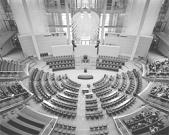
- a)der Bundesadler
- b)die Fahne der Stadt Berlin
- c)der Reichsadler
- d)die Reichskrone
›Show answer
Correct answer: a) der Bundesadler
In English
Which symbol can be seen in the plenary chamber of the German Bundestag?
- a) the federal eagle (Bundesadler)
- b) the flag of the city of Berlin
- c) the imperial eagle (Reichsadler)
- d) the imperial crown (Reichskrone)
Explanation: The image shows the Bundestag's plenary chamber, where a large federal eagle hangs on the front wall behind the President's seat. The federal eagle is a state symbol of the Federal Republic, while the imperial eagle belonged to the former German Reich.
Question 217
In welchem Zeitraum gab es die Deutsche Demokratische Republik (DDR)?
- a)1919 bis 1927
- b)1933 bis 1945
- c)1945 bis 1961
- d)1949 bis 1990
›Show answer
Correct answer: d) 1949 bis 1990
In English
During which period did the German Democratic Republic (GDR) exist?
- a) 1919 to 1927
- b) 1933 to 1945
- c) 1945 to 1961
- d) 1949 to 1990
Explanation: The GDR was founded in 1949 in the Soviet occupation zone and ceased to exist in 1990 when it joined the Federal Republic. 1933 to 1945 was the period of National Socialism.
Question 218
Wie viele Bundesländer kamen bei der Wiedervereinigung 1990 zur Bundesrepublik Deutschland hinzu?
- a)4
- b)5
- c)6
- d)7
›Show answer
Correct answer: b) 5
In English
How many federal states joined the Federal Republic of Germany at reunification in 1990?
- a) 4
- b) 5
- c) 6
- d) 7
Explanation: Five new states joined in 1990: Brandenburg, Mecklenburg-Western Pomerania, Saxony, Saxony-Anhalt and Thuringia. East Berlin was united with West Berlin as the state of Berlin, which is why Germany has 16 federal states today.
Question 219
Die Bundesrepublik Deutschland hat die Grenzen von heute seit …
- a)1933.
- b)1949.
- c)1971.
- d)1990.
›Show answer
Correct answer: d) 1990.
In English
The Federal Republic of Germany has had its present borders since …
- a) 1933.
- b) 1949.
- c) 1971.
- d) 1990.
Explanation: Germany has had its present borders since reunification in 1990. The Two Plus Four Treaty (Zwei-plus-Vier-Vertrag) fixed its external borders, including the final recognition of the Oder–Neisse border with Poland.
Question 220
Der 27. Januar ist in Deutschland ein offizieller Gedenktag. Woran erinnert dieser Tag?
- a)an das Ende des Zweiten Weltkrieges
- b)an die Verabschiedung des Grundgesetzes
- c)an die Wiedervereinigung Deutschlands
- d)an die Opfer des Nationalsozialismus (Tag der Befreiung des Vernichtungslagers Auschwitz)
›Show answer
Correct answer: d) an die Opfer des Nationalsozialismus (Tag der Befreiung des Vernichtungslagers Auschwitz)
In English
27 January is an official day of remembrance in Germany. What does this day commemorate?
- a) the end of the Second World War
- b) the adoption of the Basic Law (Grundgesetz)
- c) the reunification of Germany
- d) the victims of National Socialism (the day the Auschwitz extermination camp was liberated)
Explanation: On 27 January 1945 the Soviet army liberated the Auschwitz extermination camp. Since 1996 Germany has marked this date as the Day of Remembrance for the Victims of National Socialism. The Second World War in Europe ended on 8 May 1945.
Question 221
Deutschland ist Mitglied des Schengener Abkommens. Was bedeutet das?
- a)Deutsche können in viele Länder Europas ohne Passkontrolle reisen.
- b)Alle Menschen können ohne Personenkontrolle in Deutschland einreisen.
- c)Deutsche können ohne Passkontrolle in jedes Land reisen.
- d)Deutsche können in jedem Land mit dem Euro bezahlen.
›Show answer
Correct answer: a) Deutsche können in viele Länder Europas ohne Passkontrolle reisen.
In English
Germany is a member of the Schengen Agreement. What does that mean?
- a) Germans can travel to many European countries without passport checks.
- b) Anyone can enter Germany without identity checks.
- c) Germans can travel to any country without passport checks.
- d) Germans can pay with the euro in every country.
Explanation: Countries in the Schengen Area generally do not carry out regular checks at their shared borders, so Germans can travel to many European countries without passport checks. This does not apply to every country in the world, nor does it mean that anyone may enter Germany unchecked.
Question 222
Welches Land ist ein Nachbarland von Deutschland?
- a)Ungarn
- b)Portugal
- c)Spanien
- d)Schweiz
›Show answer
Correct answer: d) Schweiz
In English
Which country is a neighbour of Germany?
- a) Hungary
- b) Portugal
- c) Spain
- d) Switzerland
Explanation: Switzerland borders Germany to the south. Germany has nine neighbours: Denmark, Poland, Czechia, Austria, Switzerland, France, Luxembourg, Belgium and the Netherlands; Hungary, Portugal and Spain are not among them.
Question 223
Welches Land ist ein Nachbarland von Deutschland?
- a)Rumänien
- b)Bulgarien
- c)Polen
- d)Griechenland
›Show answer
Correct answer: c) Polen
In English
Which country is a neighbour of Germany?
- a) Romania
- b) Bulgaria
- c) Poland
- d) Greece
Explanation: Poland borders Germany to the east. Germany has nine neighbours: Denmark, Poland, Czechia, Austria, Switzerland, France, Luxembourg, Belgium and the Netherlands; Romania, Bulgaria and Greece are not among them.
Question 224
Was bedeutet die Abkürzung EU?
- a)Europäische Unternehmen
- b)Europäische Union
- c)Einheitliche Union
- d)Euro Union
›Show answer
Correct answer: b) Europäische Union
In English
What does the abbreviation EU stand for?
- a) European Companies (Europäische Unternehmen)
- b) European Union (Europäische Union)
- c) Unified Union (Einheitliche Union)
- d) Euro Union (Euro Union)
Explanation: EU stands for „Europäische Union“, the European Union. Germany is one of its founding members.
Question 225
In welchem anderen Land gibt es eine große deutschsprachige Bevölkerung?
- a)Tschechien
- b)Norwegen
- c)Spanien
- d)Österreich
›Show answer
Correct answer: d) Österreich
In English
In which other country is there a large German-speaking population?
- a) Czechia
- b) Norway
- c) Spain
- d) Austria
Explanation: German is the official language of Austria, and most of its population speaks German. German is also spoken in Switzerland and Liechtenstein, whereas Czechia, Norway and Spain have other official languages.
Question 226
Welche ist die Flagge der Europäischen Union?
- a)

- b)

- c)

- d)

›Show answer
Correct answer: b) Option 2
In English
Which is the flag of the European Union?
Explanation: The EU flag shows twelve golden stars in a circle on a blue background, as in image 2. Image 1 is the flag of the USA and image 3 that of the United Nations.
- a)
Question 227
Welches Land ist ein Nachbarland von Deutschland?
- a)Finnland
- b)Dänemark
- c)Norwegen
- d)Schweden
›Show answer
Correct answer: b) Dänemark
In English
Which country is a neighbour of Germany?
- a) Finland
- b) Denmark
- c) Norway
- d) Sweden
Explanation: Denmark borders Germany to the north. Germany has nine neighbours: Denmark, Poland, Czechia, Austria, Switzerland, France, Luxembourg, Belgium and the Netherlands; Finland, Norway and Sweden do not share a land border with Germany.
Question 228
Wie wird der Beitritt der DDR zur Bundesrepublik Deutschland im Jahr 1990 allgemein genannt?
- a)NATO-Osterweiterung
- b)EU-Osterweiterung
- c)Deutsche Wiedervereinigung
- d)Europäische Gemeinschaft
›Show answer
Correct answer: c) Deutsche Wiedervereinigung
In English
What is the GDR's accession to the Federal Republic of Germany in 1990 generally called?
- a) NATO's eastward enlargement (NATO-Osterweiterung)
- b) the EU's eastward enlargement (EU-Osterweiterung)
- c) German reunification (Deutsche Wiedervereinigung)
- d) the European Community (Europäische Gemeinschaft)
Explanation: The GDR's accession to the Federal Republic on 3 October 1990 is known as German reunification. The eastward enlargements of NATO and the EU came later, when Eastern European countries joined.
Question 229
Welches Land ist ein Nachbarland von Deutschland?
- a)Spanien
- b)Bulgarien
- c)Norwegen
- d)Luxemburg
›Show answer
Correct answer: d) Luxemburg
In English
Which country is a neighbour of Germany?
- a) Spain
- b) Bulgaria
- c) Norway
- d) Luxembourg
Explanation: Luxembourg borders Germany to the west. Germany has nine neighbours: Denmark, Poland, Czechia, Austria, Switzerland, France, Luxembourg, Belgium and the Netherlands; Spain, Bulgaria and Norway are not among them.
Question 230
Das Europäische Parlament wird regelmäßig gewählt, nämlich alle …
- a)5 Jahre.
- b)6 Jahre.
- c)7 Jahre.
- d)8 Jahre.
›Show answer
Correct answer: a) 5 Jahre.
In English
The European Parliament is elected regularly, namely every …
- a) 5 years.
- b) 6 years.
- c) 7 years.
- d) 8 years.
Explanation: The European Parliament is elected every five years. In the 2024 election, 16-year-olds in Germany were also able to vote.
Question 231
Was bedeutet der Begriff „europäische Integration“?
- a)Damit sind amerikanische Einwanderer in Europa gemeint.
- b)Der Begriff meint den Einwanderungsstopp nach Europa.
- c)Damit sind europäische Auswanderer in den USA gemeint.
- d)Der Begriff meint den Zusammenschluss europäischer Staaten zur EU.
›Show answer
Correct answer: d) Der Begriff meint den Zusammenschluss europäischer Staaten zur EU.
In English
What does the term ‘European integration’ (europäische Integration) mean?
- a) It refers to American immigrants in Europe.
- b) The term refers to the halt on immigration to Europe.
- c) It refers to European emigrants in the USA.
- d) The term refers to European states joining together to form the EU.
Explanation: European integration is the process by which European states have cooperated ever more closely, economically and politically, and joined together in today's European Union. The term has nothing to do with immigration or emigrants.
Question 232
Wer wird bei der Europawahl gewählt?
- a)die Europäische Kommission
- b)die Länder, die in die EU eintreten dürfen
- c)die Abgeordneten des Europäischen Parlaments
- d)die europäische Verfassung
›Show answer
Correct answer: c) die Abgeordneten des Europäischen Parlaments
In English
Who is elected in the European elections?
- a) the European Commission
- b) the countries that are allowed to join the EU
- c) the Members of the European Parliament
- d) the European constitution
Explanation: In the European elections, EU citizens directly elect the Members of the European Parliament. The European Commission is not elected by voters; it takes office on the proposal of the member states and with Parliament's approval.
Question 233
Welches Land ist ein Nachbarland von Deutschland?
- a)Tschechien
- b)Bulgarien
- c)Griechenland
- d)Portugal
›Show answer
Correct answer: a) Tschechien
In English
Which country is a neighbour of Germany?
- a) Czechia
- b) Bulgaria
- c) Greece
- d) Portugal
Explanation: Czechia borders Germany to the east and south-east. Germany has nine neighbours: Denmark, Poland, Czechia, Austria, Switzerland, France, Luxembourg, Belgium and the Netherlands; Bulgaria, Greece and Portugal are not among them.
Question 234
Wo ist ein Sitz des Europäischen Parlaments?
- a)London
- b)Paris
- c)Berlin
- d)Straßburg
›Show answer
Correct answer: d) Straßburg
In English
Where is one of the seats of the European Parliament?
- a) London
- b) Paris
- c) Berlin
- d) Strasbourg
Explanation: The official seat of the European Parliament is Strasbourg in France, where most plenary sessions are held. Parliament also works in Brussels and Luxembourg.
Question 235
Der damalige französische Staatspräsident François Mitterrand und der damalige deutsche Bundeskanzler Helmut Kohl gedenken in Verdun gemeinsam der Toten beider Weltkriege. Welches Ziel der Europäischen Union wird bei diesem Treffen deutlich?
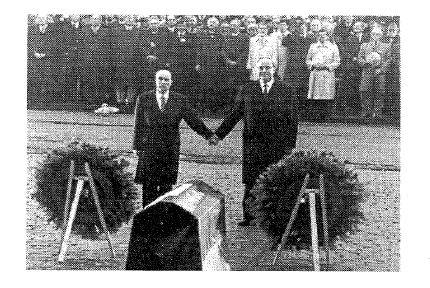
- a)Freundschaft zwischen England und Deutschland
- b)Reisefreiheit in alle Länder der EU
- c)Frieden und Sicherheit in den Ländern der EU
- d)einheitliche Feiertage in den Ländern der EU
›Show answer
Correct answer: c) Frieden und Sicherheit in den Ländern der EU
In English
The then French President François Mitterrand and the then German Federal Chancellor Helmut Kohl jointly commemorate the dead of both world wars at Verdun. Which aim of the European Union becomes clear at this meeting?
- a) friendship between England and Germany
- b) freedom to travel to all EU countries
- c) peace and security in the EU countries
- d) uniform public holidays in the EU countries
Explanation: The photo shows Mitterrand and Kohl standing hand in hand at Verdun in 1984, where German and French soldiers fought one of the bloodiest battles of the First World War. The gesture symbolises reconciliation between former enemies and peace, a core aim of the EU.
Question 236
Wie viele Mitgliedstaaten hat die EU heute?
- a)21
- b)23
- c)25
- d)27
›Show answer
Correct answer: d) 27
In English
How many member states does the EU have today?
- a) 21
- b) 23
- c) 25
- d) 27
Explanation: The European Union has 27 member states (as of November 2026). The number has been 27 since the United Kingdom left in 2020.
The answer to this question can change over time (situation in November 2026).
Question 237
2007 wurde das 50-jährige Jubiläum der „Römischen Verträge“ gefeiert. Was war der Inhalt der Verträge?
- a)Beitritt Deutschlands zur NATO
- b)Gründung der Europäischen Wirtschaftsgemeinschaft (EWG)
- c)Verpflichtung Deutschlands zu Reparationsleistungen
- d)Festlegung der Oder-Neiße-Linie als Ostgrenze
›Show answer
Correct answer: b) Gründung der Europäischen Wirtschaftsgemeinschaft (EWG)
In English
In 2007 the 50th anniversary of the ‘Treaties of Rome’ (Römische Verträge) was celebrated. What did the treaties contain?
- a) Germany's accession to NATO
- b) the founding of the European Economic Community (EWG)
- c) Germany's obligation to pay reparations
- d) fixing the Oder–Neisse line as the eastern border
Explanation: The Treaties of Rome, signed in 1957, founded the European Economic Community (EEC, in German EWG); the Federal Republic was one of the six founding states. The EEC is one of the forerunners of today's European Union.
Question 238
An welchen Orten arbeitet das Europäische Parlament?
- a)Paris, London und Den Haag
- b)Straßburg, Luxemburg und Brüssel
- c)Rom, Bern und Wien
- d)Bonn, Zürich und Mailand
›Show answer
Correct answer: b) Straßburg, Luxemburg und Brüssel
In English
In which places does the European Parliament work?
- a) Paris, London and The Hague
- b) Strasbourg, Luxembourg and Brussels
- c) Rome, Bern and Vienna
- d) Bonn, Zurich and Milan
Explanation: The European Parliament works in three places: most plenary sessions are held in Strasbourg, committee meetings and some sessions take place in Brussels, and its General Secretariat is based in Luxembourg.
Question 239
Durch welche Verträge schloss sich die Bundesrepublik Deutschland mit anderen Staaten zur Europäischen Wirtschaftsgemeinschaft zusammen?
- a)durch die „Hamburger Verträge“
- b)durch die „Römischen Verträge“
- c)durch die „Pariser Verträge“
- d)durch die „Londoner Verträge“
›Show answer
Correct answer: b) durch die „Römischen Verträge“
In English
Through which treaties did the Federal Republic of Germany join with other states to form the European Economic Community?
- a) through the Treaties of Hamburg (Hamburger Verträge)
- b) through the Treaties of Rome (Römische Verträge)
- c) through the Treaties of Paris (Pariser Verträge)
- d) through the Treaties of London (Londoner Verträge)
Explanation: The Federal Republic founded the European Economic Community together with Belgium, France, Italy, Luxembourg and the Netherlands through the Treaties of Rome, signed in 1957. The Treaty of Paris of 1951 had set up the European Coal and Steel Community.
Question 240
Seit wann bezahlt man in Deutschland mit dem Euro in bar?
- a)1995
- b)1998
- c)2002
- d)2005
›Show answer
Correct answer: c) 2002
In English
Since when have people in Germany been paying in cash with the euro?
- a) 1995
- b) 1998
- c) 2002
- d) 2005
Explanation: The euro was introduced as book money in 1999; euro notes and coins came into circulation on 1 January 2002. Until then, cash payments in Germany were made in Deutsche Marks.
Question 241
Frau Seger bekommt ein Kind. Was muss sie tun, um Elterngeld zu erhalten?
- a)Sie muss an ihre Krankenkasse schreiben.
- b)Sie muss einen Antrag bei der Elterngeldstelle stellen.
- c)Sie muss nichts tun, denn sie bekommt automatisch Elterngeld.
- d)Sie muss das Arbeitsamt um Erlaubnis bitten.
›Show answer
Correct answer: b) Sie muss einen Antrag bei der Elterngeldstelle stellen.
In English
Ms Seger is having a baby. What does she have to do to receive parental allowance (Elterngeld)?
- a) She has to write to her health insurance fund (Krankenkasse).
- b) She has to submit an application to the parental allowance office (Elterngeldstelle).
- c) She does not have to do anything, because she receives parental allowance automatically.
- d) She has to ask the employment office (Arbeitsamt) for permission.
Explanation: Parental allowance (Elterngeld) is not paid automatically; you have to apply for it at the parental allowance office (Elterngeldstelle). The health insurance fund pays maternity benefit (Mutterschaftsgeld), but parental allowance requires a separate application.
Question 242
Wer entscheidet, ob ein Kind in Deutschland in den Kindergarten geht?
- a)der Staat
- b)die Bundesländer
- c)die Eltern/die Erziehungsberechtigten
- d)die Schulen
›Show answer
Correct answer: c) die Eltern/die Erziehungsberechtigten
In English
Who decides whether a child in Germany goes to kindergarten?
- a) the state
- b) the federal states
- c) the parents / legal guardians
- d) the schools
Explanation: Kindergarten is not compulsory in Germany, so the parents or legal guardians decide whether their child attends. School attendance is compulsory, kindergarten is not.
Question 243
Maik und Sybille wollen mit Freunden an ihrem deutschen Wohnort eine Demonstration auf der Straße abhalten. Was müssen sie vorher tun?
- a)Sie müssen die Demonstration anmelden.
- b)Sie müssen nichts tun. Man darf in Deutschland jederzeit überall demonstrieren.
- c)Sie können gar nichts tun, denn Demonstrationen sind in Deutschland grundsätzlich verboten.
- d)Maik und Sybille müssen einen neuen Verein gründen, weil nur Vereine demonstrieren dürfen.
›Show answer
Correct answer: a) Sie müssen die Demonstration anmelden.
In English
Maik and Sybille want to hold a street demonstration with friends in the German town where they live. What do they have to do beforehand?
- a) They have to register the demonstration.
- b) They do not have to do anything. In Germany you may demonstrate anywhere at any time.
- c) They cannot do anything, because demonstrations are generally banned in Germany.
- d) Maik and Sybille have to found a new association, because only associations may demonstrate.
Explanation: Freedom of assembly is protected by Article 8 of the Basic Law, but open-air demonstrations must be registered in advance with the responsible authority. No permission is needed, only notification.
Question 244
Welchen Schulabschluss braucht man normalerweise, um an einer Universität in Deutschland ein Studium zu beginnen?
- a)das Abitur
- b)ein Diplom
- c)die Prokura
- d)eine Gesellenprüfung
›Show answer
Correct answer: a) das Abitur
In English
Which school-leaving qualification do you normally need to start studying at a university in Germany?
- a) the school-leaving certificate (Abitur)
- b) a diploma (Diplom)
- c) commercial power of attorney (Prokura)
- d) a journeyman's examination (Gesellenprüfung)
Explanation: The Abitur is the qualification gained at the end of the Gymnasium or similar schools, and it gives access to university studies. A Diplom is a university degree, and Prokura is a commercial power of attorney within a company.
Question 245
Wer darf in Deutschland nicht als Paar zusammenleben?
- a)Hans (20 Jahre) und Marie (19 Jahre)
- b)Tom (20 Jahre) und Klaus (45 Jahre)
- c)Sofie (35 Jahre) und Lisa (40 Jahre)
- d)Anne (13 Jahre) und Tim (25 Jahre)
›Show answer
Correct answer: d) Anne (13 Jahre) und Tim (25 Jahre)
In English
Who is not allowed to live together as a couple in Germany?
- a) Hans (20 years old) and Marie (19 years old)
- b) Tom (20 years old) and Klaus (45 years old)
- c) Sofie (35 years old) and Lisa (40 years old)
- d) Anne (13 years old) and Tim (25 years old)
Explanation: Children under 14 are specially protected from sexual abuse by criminal law, so a 13-year-old cannot be in a couple with a 25-year-old adult. Adult couples, including same-sex couples or couples with a large age gap, may live together.
Question 246
Ab welchem Alter ist man in Deutschland volljährig?
- a)16
- b)18
- c)19
- d)21
›Show answer
Correct answer: b) 18
In English
At what age do you come of age in Germany?
- a) 16
- b) 18
- c) 19
- d) 21
Explanation: In Germany you come of age at 18. From then on you can, for example, sign contracts on your own and, if you are a German citizen, vote in Bundestag elections.
Question 247
Eine Frau ist schwanger. Sie ist kurz vor und nach der Geburt ihres Kindes vom Gesetz besonders beschützt. Wie heißt dieser Schutz?
- a)Elternzeit
- b)Mutterschutz
- c)Geburtsvorbereitung
- d)Wochenbett
›Show answer
Correct answer: b) Mutterschutz
In English
A woman is pregnant. Shortly before and after the birth of her child she is specially protected by law. What is this protection called?
- a) parental leave (Elternzeit)
- b) maternity protection (Mutterschutz)
- c) antenatal preparation (Geburtsvorbereitung)
- d) the postnatal period (Wochenbett)
Explanation: Maternity protection (Mutterschutz) protects working women for six weeks before and eight weeks after the birth; as a rule they do not work during this time. Parental leave (Elternzeit) is a longer period of leave that mothers or fathers can take after the birth.
Question 248
Die Erziehung der Kinder ist in Deutschland vor allem Aufgabe …
- a)des Staates.
- b)der Eltern.
- c)der Großeltern.
- d)der Schulen.
›Show answer
Correct answer: b) der Eltern.
In English
In Germany, bringing up children is above all the task of …
- a) the state.
- b) the parents.
- c) the grandparents.
- d) the schools.
Explanation: Under Article 6 of the Basic Law, the care and upbringing of children are the natural right of parents and first and foremost their duty. The state only watches over how they carry it out.
Question 249
Wer ist in Deutschland hauptsächlich verantwortlich für die Kindererziehung?
- a)der Staat
- b)die Eltern
- c)die Verwandten
- d)die Schulen
›Show answer
Correct answer: b) die Eltern
In English
Who is mainly responsible for bringing up children in Germany?
- a) the state
- b) the parents
- c) the relatives
- d) the schools
Explanation: Bringing up children is primarily the right and duty of the parents (Article 6(2) of the Basic Law). Schools and the state provide support, but the main responsibility lies with the parents.
Question 250
In Deutschland hat man die besten Chancen auf einen gut bezahlten Arbeitsplatz, wenn man …
- a)katholisch ist.
- b)gut ausgebildet ist.
- c)eine Frau ist.
- d)Mitglied einer Partei ist.
›Show answer
Correct answer: b) gut ausgebildet ist.
In English
In Germany you have the best chance of getting a well-paid job if you …
- a) are Catholic.
- b) are well trained.
- c) are a woman.
- d) are a member of a party.
Explanation: What counts most for a well-paid job in Germany is education and professional qualifications, not religion, gender or party membership. Discrimination on the grounds of religion or gender is prohibited anyway.
Questions for your federal state
Each state's 10 questions with answers, translation and explanations on their own page.
- Baden-Württemberg
- Bavaria (Bayern)
- Berlin
- Brandenburg
- Bremen
- Hamburg
- Hesse (Hessen)
- Mecklenburg-Vorpommern
- Lower Saxony (Niedersachsen)
- North Rhine-Westphalia (Nordrhein-Westfalen)
- Rhineland-Palatinate (Rheinland-Pfalz)
- Saarland
- Saxony (Sachsen)
- Saxony-Anhalt (Sachsen-Anhalt)
- Schleswig-Holstein
- Thuringia (Thüringen)
Citizenship also requires B1 German
Besides this knowledge test, a citizenship application needs a German certificate at level B1 or higher (for example telc Deutsch B1, the DTZ or the Goethe-Zertifikat B1). Our guide explains which certificates are accepted, and the free placement test shows where you stand.