Leben in Deutschland test: all 310 questions with answers
The „Leben in Deutschland“ test and the German citizenship test (Einbürgerungstest) use the same official question catalogue: 300 general questions plus the 10 questions of the federal state you live in. Practise all of them here with an English translation and a short explanation, or sit a 33-question mock test under real conditions. No sign-up needed.
The test in brief
- 33 questions: 30 general questions and 3 questions about your federal state. Time: 60 minutes.
- Each question has four options and exactly one correct answer.
- For citizenship you need at least 17 correct answers.
- In the „Leben in Deutschland“ test of the integration course, 15 correct answers are enough for the certificate; 17 or more also count for a citizenship application.
Registration, fee, test centres and exemptions: our Leben in Deutschland test guide
Where do the questions and answers come from?
The German wording of the questions and options is taken unchanged from the official catalogue: Annex 1 of the Citizenship Test Ordinance (Einbürgerungstestverordnung). For the 5 questions whose content BAMF updated in its catalogue of 7 May 2025 (for example the question on the current chancellor) we use BAMF's wording. The images also come from the ordinance.
The catalogue does not mark the correct answers. We built the answer key from two independent solutions and then checked it against the answers in BAMF's online catalogue. The English translations and explanations are by Level Exams; in the test itself the questions are asked in German only.
Questions whose answer changes over time (the current chancellor, the parliamentary groups, population and similar) are marked and show the situation in November 2026. Level Exams is not affiliated with BAMF, telc gGmbH, ÖSD or the Goethe-Institut.
All 300 general questions with answers
The questions follow the order of the official catalogue. Answer first, then press „Show answer“ to see the correct option, an English translation and an explanation.
Questions 1–50
Question 1
In Deutschland dürfen Menschen offen etwas gegen die Regierung sagen, weil …
- a)hier Religionsfreiheit gilt.
- b)die Menschen Steuern zahlen.
- c)die Menschen das Wahlrecht haben.
- d)hier Meinungsfreiheit gilt.
›Show answer
Correct answer: d) hier Meinungsfreiheit gilt.
In English
In Germany people may openly say something against the government because …
- a) freedom of religion applies here.
- b) people pay taxes.
- c) people have the right to vote.
- d) freedom of expression applies here.
Explanation: Freedom of expression (Meinungsfreiheit) is guaranteed by Article 5 of the Basic Law, and openly criticising the government is part of it. Freedom of religion and the right to vote are fundamental rights too, but they do not answer this question.
Question 2
In Deutschland können Eltern bis zum 14. Lebensjahr ihres Kindes entscheiden, ob es in der Schule am …
- a)Geschichtsunterricht teilnimmt.
- b)Religionsunterricht teilnimmt.
- c)Politikunterricht teilnimmt.
- d)Sprachunterricht teilnimmt.
›Show answer
Correct answer: b) Religionsunterricht teilnimmt.
In English
In Germany, until their child turns 14, parents can decide whether the child takes part at school in …
- a) history lessons.
- b) religious education.
- c) politics lessons.
- d) language lessons.
Explanation: Religious education is usually a regular subject in state schools, but parents decide whether their child takes part (Article 7(2) of the Basic Law). From the age of 14 the child makes this decision alone.
Question 3
Deutschland ist ein Rechtsstaat. Was ist damit gemeint?
- a)Alle Einwohner / Einwohnerinnen und der Staat müssen sich an die Gesetze halten.
- b)Der Staat muss sich nicht an die Gesetze halten.
- c)Nur Deutsche müssen die Gesetze befolgen.
- d)Die Gerichte machen die Gesetze.
›Show answer
Correct answer: a) Alle Einwohner / Einwohnerinnen und der Staat müssen sich an die Gesetze halten.
In English
Germany is a state under the rule of law (Rechtsstaat). What does this mean?
- a) All residents and the state must obey the law.
- b) The state does not have to obey the law.
- c) Only Germans have to obey the law.
- d) The courts make the laws.
Explanation: In a state under the rule of law, not only the people but the state itself is bound by the law (Article 20(3) of the Basic Law). Laws are made by parliament, not by the courts; the courts apply them.
Question 4
Welches Recht gehört zu den Grundrechten in Deutschland?
- a)Waffenbesitz
- b)Faustrecht
- c)Meinungsfreiheit
- d)Selbstjustiz
›Show answer
Correct answer: c) Meinungsfreiheit
In English
Which right is one of the fundamental rights in Germany?
- a) Possession of weapons
- b) Rule of force
- c) Freedom of expression
- d) Taking the law into one's own hands
Explanation: Freedom of expression is guaranteed by Article 5 of the Basic Law. Using force or punishing others yourself is forbidden, as only the state may use force. Owning a weapon is not a fundamental right; firearms require a permit.
Question 5
Wahlen in Deutschland sind frei. Was bedeutet das?
- a)Man darf Geld annehmen, wenn man dafür einen bestimmten Kandidaten/eine bestimmte Kandidatin wählt.
- b)Nur Personen, die noch nie im Gefängnis waren, dürfen wählen.
- c)Der Wähler darf bei der Wahl weder beeinflusst noch zu einer bestimmten Stimmabgabe gezwungen werden und keine Nachteile durch die Wahl haben.
- d)Alle wahlberechtigten Personen müssen wählen.
›Show answer
Correct answer: c) Der Wähler darf bei der Wahl weder beeinflusst noch zu einer bestimmten Stimmabgabe gezwungen werden und keine Nachteile durch die Wahl haben.
In English
Elections in Germany are free. What does that mean?
- a) You may accept money for voting for a particular candidate.
- b) Only people who have never been in prison may vote.
- c) Voters may not be influenced or forced to vote in a particular way and must not suffer any disadvantage because of the election.
- d) Everyone entitled to vote must vote.
Explanation: Free elections mean that no one may be pushed towards a particular vote by pressure, threats or money (Article 38(1) of the Basic Law). There is no compulsory voting in Germany, and buying votes is a criminal offence.
Question 6
Wie heißt die deutsche Verfassung?
- a)Volksgesetz
- b)Bundesgesetz
- c)Deutsches Gesetz
- d)Grundgesetz
›Show answer
Correct answer: d) Grundgesetz
In English
What is the German constitution called?
- a) People's Law (Volksgesetz)
- b) Federal Law (Bundesgesetz)
- c) German Law (Deutsches Gesetz)
- d) Basic Law (Grundgesetz)
Explanation: Germany's constitution is called the Basic Law (Grundgesetz); it came into force in 1949. The other names are not used for the German constitution.
Question 7
Welches Recht gehört zu den Grundrechten, die nach der deutschen Verfassung garantiert werden? Das Recht auf …
- a)Glaubens- und Gewissensfreiheit
- b)Unterhaltung
- c)Arbeit
- d)Wohnung
›Show answer
Correct answer: a) Glaubens- und Gewissensfreiheit
In English
Which right is one of the fundamental rights guaranteed by the German constitution? The right to …
- a) freedom of belief and conscience
- b) entertainment
- c) work
- d) housing
Explanation: Freedom of belief and conscience is guaranteed by Article 4 of the Basic Law. A right to work or to housing is not one of the fundamental rights in the Basic Law; the state supports people in these areas through social benefits.
Question 8
Was steht nicht im Grundgesetz von Deutschland?
- a)Die Würde des Menschen ist unantastbar.
- b)Alle sollen gleich viel Geld haben.
- c)Jeder Mensch darf seine Meinung sagen.
- d)Alle sind vor dem Gesetz gleich.
›Show answer
Correct answer: b) Alle sollen gleich viel Geld haben.
In English
What is not in Germany's Basic Law?
- a) Human dignity shall be inviolable.
- b) Everyone should have the same amount of money.
- c) Everyone may say what they think.
- d) All persons are equal before the law.
Explanation: The Basic Law protects human dignity (Article 1), freedom of expression (Article 5) and equality before the law (Article 3). It contains no rule that everyone should have the same amount of money; property is in fact protected (Article 14).
Question 9
Welches Grundrecht gilt in Deutschland nur für Ausländer / Ausländerinnen? Das Grundrecht auf …
- a)Schutz der Familie
- b)Menschenwürde
- c)Asyl
- d)Meinungsfreiheit
›Show answer
Correct answer: c) Asyl
In English
Which fundamental right in Germany applies only to foreigners? The fundamental right to …
- a) protection of the family
- b) human dignity
- c) asylum
- d) freedom of expression
Explanation: People persecuted on political grounds have the right of asylum (Article 16a of the Basic Law). German citizens do not need asylum in their own country, so this right concerns only foreigners. Human dignity, protection of the family and freedom of expression apply to everyone.
Question 10
Was ist mit dem deutschen Grundgesetz vereinbar?
- a)die Prügelstrafe
- b)die Folter
- c)die Todesstrafe
- d)die Geldstrafe
›Show answer
Correct answer: d) die Geldstrafe
In English
What is compatible with the German Basic Law?
- a) corporal punishment
- b) torture
- c) the death penalty
- d) fines
Explanation: A fine is a normal penalty that courts may impose. The death penalty is abolished (Article 102 of the Basic Law), and torture and corporal punishment are forbidden because they violate human dignity.
Question 11
Wie wird die Verfassung der Bundesrepublik Deutschland genannt?
- a)Grundgesetz
- b)Bundesverfassung
- c)Gesetzbuch
- d)Verfassungsvertrag
›Show answer
Correct answer: a) Grundgesetz
In English
What is the constitution of the Federal Republic of Germany called?
- a) Basic Law (Grundgesetz)
- b) Federal Constitution (Bundesverfassung)
- c) Code of Law (Gesetzbuch)
- d) Constitutional Treaty (Verfassungsvertrag)
Explanation: Germany's constitution is called the Basic Law (Grundgesetz) and has been in force since 1949. The name reflects that it was originally intended as a provisional order until Germany was reunited.
Question 12
Eine Partei im Deutschen Bundestag will die Pressefreiheit abschaffen. Ist das möglich?
- a)Ja, wenn mehr als die Hälfte der Abgeordneten im Bundestag dafür sind.
- b)Ja, aber dazu müssen zwei Drittel der Abgeordneten im Bundestag dafür sein.
- c)Nein, denn die Pressefreiheit ist ein Grundrecht. Sie kann nicht abgeschafft werden.
- d)Nein, denn nur der Bundesrat kann die Pressefreiheit abschaffen.
›Show answer
Correct answer: c) Nein, denn die Pressefreiheit ist ein Grundrecht. Sie kann nicht abgeschafft werden.
In English
A party in the German Bundestag wants to abolish freedom of the press. Is that possible?
- a) Yes, if more than half of the members of the Bundestag are in favour.
- b) Yes, but two thirds of the members of the Bundestag must be in favour.
- c) No, because freedom of the press is a fundamental right. It cannot be abolished.
- d) No, because only the Bundesrat can abolish freedom of the press.
Explanation: Freedom of the press is a fundamental right guaranteed by Article 5 of the Basic Law. Fundamental rights may be restricted by law only to a limited extent, and their essential content may never be touched (Article 19(2) of the Basic Law); a parliamentary majority cannot abolish them.
Question 13
Im Parlament steht der Begriff „Opposition“ für ...
- a)die regierenden Parteien.
- b)die Fraktion mit den meisten Abgeordneten.
- c)alle Parteien, die bei der letzten Wahl die 5 %-Hürde erreichen konnten.
- d)alle Abgeordneten, die nicht zu der Regierungspartei/den Regierungsparteien gehören.
›Show answer
Correct answer: d) alle Abgeordneten, die nicht zu der Regierungspartei/den Regierungsparteien gehören.
In English
In parliament, the term „Opposition“ refers to …
- a) the governing parties.
- b) the parliamentary group (Fraktion) with the most members.
- c) all parties that managed to pass the 5% threshold in the last election.
- d) all members of parliament who do not belong to the governing party or parties.
Explanation: The opposition consists of all members of parliament who do not belong to the parties forming the government. Its task is to scrutinise and criticise the government and to offer alternatives.
Question 14
Meinungsfreiheit in Deutschland heißt zum Beispiel, dass ich
- a)Passanten auf der Straße beschimpfen darf
- b)meine Meinung im Internet äußern kann
- c)Nazi-, Hamas- oder Islamischer Staat-Symbole öffentlich tragen darf
- d)meine Meinung nur dann äußern darf, solange ich der Regierung nicht widerspreche
›Show answer
Correct answer: b) meine Meinung im Internet äußern kann
In English
Freedom of expression in Germany means, for example, that I …
- a) may insult passers-by in the street
- b) can express my opinion on the internet
- c) may wear Nazi, Hamas or Islamic State symbols in public
- d) may express my opinion only as long as I do not contradict the government
Explanation: Expressing your opinion online is part of freedom of expression. The freedom has limits, however: insulting others is a criminal offence, and Nazi symbols and the signs of banned organisations such as Hamas or Islamic State may not be displayed in public. Criticising the government is allowed.
Question 15
Was verbietet das deutsche Grundgesetz?
- a)Militärdienst
- b)Zwangsarbeit
- c)freie Berufswahl
- d)Arbeit im Ausland
›Show answer
Correct answer: b) Zwangsarbeit
In English
What does the German Basic Law prohibit?
- a) Military service
- b) Forced labour
- c) Free choice of occupation
- d) Working abroad
Explanation: Article 12 of the Basic Law prohibits forced labour; the only exception concerns people deprived of their liberty by a court order. Free choice of occupation is a protected right, and the Basic Law allows military service.
Question 16
Wann ist die Meinungsfreiheit in Deutschland eingeschränkt?
- a)bei der öffentlichen Verbreitung falscher Behauptungen über einzelne Personen
- b)bei Meinungsäußerungen über die Bundesregierung
- c)bei Diskussionen über Religionen
- d)bei Kritik am Staat
›Show answer
Correct answer: a) bei der öffentlichen Verbreitung falscher Behauptungen über einzelne Personen
In English
When is freedom of expression restricted in Germany?
- a) when false claims about individual people are spread publicly
- b) when expressing opinions about the Federal Government
- c) in discussions about religions
- d) when criticising the state
Explanation: Freedom of expression is limited, among other things, by the protection of personal honour (Article 5(2) of the Basic Law). Publicly spreading false claims about a person can be punished, for example as defamation. Criticising the government or the state and discussing religions are allowed.
Question 17
Die deutschen Gesetze verbieten …
- a)Meinungsfreiheit der Einwohner und Einwohnerinnen.
- b)Petitionen der Bürger und Bürgerinnen.
- c)Versammlungsfreiheit der Einwohner und Einwohnerinnen.
- d)Ungleichbehandlung der Bürger und Bürgerinnen durch den Staat.
›Show answer
Correct answer: d) Ungleichbehandlung der Bürger und Bürgerinnen durch den Staat.
In English
German laws prohibit …
- a) freedom of expression for residents.
- b) petitions by citizens.
- c) freedom of assembly for residents.
- d) unequal treatment of citizens by the state.
Explanation: Under Article 3 of the Basic Law all people are equal before the law, and the state may not discriminate against anyone because of their sex, origin, religion or other reasons. Freedom of expression, the right of petition and freedom of assembly are not prohibited; they are protected fundamental rights.
Question 18
Welches Grundrecht ist in Artikel 1 des Grundgesetzes der Bundesrepublik Deutschland garantiert?
- a)die Unantastbarkeit der Menschenwürde
- b)das Recht auf Leben
- c)Religionsfreiheit
- d)Meinungsfreiheit
›Show answer
Correct answer: a) die Unantastbarkeit der Menschenwürde
In English
Which fundamental right is guaranteed in Article 1 of the Basic Law of the Federal Republic of Germany?
- a) the inviolability of human dignity
- b) the right to life
- c) freedom of religion
- d) freedom of expression
Explanation: Article 1 of the Basic Law begins with the sentence ‘Human dignity shall be inviolable’; respecting and protecting it is the duty of all state authority. The right to life is in Article 2, freedom of religion in Article 4 and freedom of expression in Article 5.
Question 19
Was versteht man unter dem Recht der „Freizügigkeit“ in Deutschland?
- a)Man darf sich seinen Wohnort selbst aussuchen.
- b)Man kann seinen Beruf wechseln.
- c)Man darf sich für eine andere Religion entscheiden.
- d)Man darf sich in der Öffentlichkeit nur leicht bekleidet bewegen.
›Show answer
Correct answer: a) Man darf sich seinen Wohnort selbst aussuchen.
In English
What is meant by the right of „Freizügigkeit“ in Germany?
- a) You may choose where you live.
- b) You can change your job.
- c) You may choose a different religion.
- d) You may only go out in public lightly dressed.
Explanation: „Freizügigkeit“ is the right to move freely within the country and to choose where you live (Article 11 of the Basic Law). Changing your job falls under occupational freedom, and changing your religion under freedom of religion.
Question 20
Eine Partei in Deutschland verfolgt das Ziel, eine Diktatur zu errichten. Sie ist dann …
- a)tolerant.
- b)rechtsstaatlich orientiert.
- c)gesetzestreu.
- d)verfassungswidrig.
›Show answer
Correct answer: d) verfassungswidrig.
In English
A party in Germany aims to establish a dictatorship. It is then …
- a) tolerant.
- b) committed to the rule of law.
- c) law-abiding.
- d) unconstitutional.
Explanation: Parties that aim to abolish the free democratic basic order are unconstitutional (Article 21 of the Basic Law). Only the Federal Constitutional Court can ban such a party.
Question 21
Welches ist das Wappen der Bundesrepublik Deutschland?
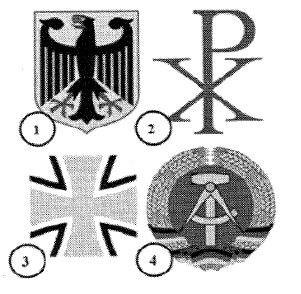
- a)1
- b)2
- c)3
- d)4
›Show answer
Correct answer: a) Option 1
In English
Which is the coat of arms of the Federal Republic of Germany?
Explanation: The federal coat of arms is the eagle on the shield in picture 1: a black eagle with a red beak and claws on a gold background (Bundesadler). Picture 4, with hammer and compass, is the coat of arms of the former GDR (East Germany).
Question 22
Was für eine Staatsform hat Deutschland?
- a)Monarchie
- b)Diktatur
- c)Republik
- d)Fürstentum
›Show answer
Correct answer: c) Republik
In English
What form of state does Germany have?
- a) Monarchy
- b) Dictatorship
- c) Republic
- d) Principality
Explanation: Germany is a republic: the head of state is not a king or a prince but the Federal President, who is elected for a fixed term.
Question 23
In Deutschland sind die meisten Erwerbstätigen …
- a)in kleinen Familienunternehmen beschäftigt.
- b)ehrenamtlich für ein Bundesland tätig.
- c)selbständig mit einer eigenen Firma tätig.
- d)bei einer Firma oder Behörde beschäftigt.
›Show answer
Correct answer: d) bei einer Firma oder Behörde beschäftigt.
In English
In Germany most people in work are …
- a) employed in small family businesses.
- b) working as volunteers for a federal state.
- c) self-employed with their own company.
- d) employed by a company or a public authority.
Explanation: The great majority of people in work in Germany are employees, working for a company or a public authority. Only a much smaller share is self-employed.
Question 24
Wie viele Bundesländer hat die Bundesrepublik Deutschland?
- a)14
- b)15
- c)16
- d)17
›Show answer
Correct answer: c) 16
In English
How many federal states does the Federal Republic of Germany have?
- a) 14
- b) 15
- c) 16
- d) 17
Explanation: Germany consists of 16 federal states (Bundesländer). Three of them, Berlin, Hamburg and Bremen, are city-states.
Question 25
Was ist kein Bundesland der Bundesrepublik Deutschland?
- a)Elsass-Lothringen
- b)Nordrhein-Westfalen
- c)Mecklenburg-Vorpommern
- d)Sachsen-Anhalt
›Show answer
Correct answer: a) Elsass-Lothringen
In English
Which of these is not a federal state of the Federal Republic of Germany?
- a) Alsace-Lorraine (Elsass-Lothringen)
- b) North Rhine-Westphalia (Nordrhein-Westfalen)
- c) Mecklenburg-Western Pomerania (Mecklenburg-Vorpommern)
- d) Saxony-Anhalt (Sachsen-Anhalt)
Explanation: Alsace-Lorraine is in France today; it belonged to the German Empire from 1871 to 1918. The other three are among Germany's 16 federal states.
Question 26
Deutschland ist …
- a)eine kommunistische Republik.
- b)ein demokratischer und sozialer Bundesstaat.
- c)eine kapitalistische und soziale Monarchie.
- d)ein sozialer und sozialistischer Bundesstaat.
›Show answer
Correct answer: b) ein demokratischer und sozialer Bundesstaat.
In English
Germany is …
- a) a communist republic.
- b) a democratic and social federal state.
- c) a capitalist and social monarchy.
- d) a social and socialist federal state.
Explanation: Article 20 of the Basic Law describes Germany as a ‘democratic and social federal state’. Germany is neither a socialist or communist state nor a monarchy.
Question 27
Deutschland ist …
- a)ein sozialistischer Staat.
- b)ein Bundesstaat.
- c)eine Diktatur.
- d)eine Monarchie.
›Show answer
Correct answer: b) ein Bundesstaat.
In English
Germany is …
- a) a socialist state.
- b) a federal state.
- c) a dictatorship.
- d) a monarchy.
Explanation: Germany is a federal state: state tasks are shared between the federal level and the 16 federal states, each of which has its own parliament and government.
Question 28
Wer wählt in Deutschland die Abgeordneten zum Bundestag?
- a)das Militär
- b)die Wirtschaft
- c)das wahlberechtigte Volk
- d)die Verwaltung
›Show answer
Correct answer: c) das wahlberechtigte Volk
In English
Who elects the members of the Bundestag in Germany?
- a) the military
- b) the business sector
- c) the people entitled to vote
- d) the administration
Explanation: The members of the Bundestag are elected by the citizens entitled to vote in general, direct, free, equal and secret elections (Article 38(1) of the Basic Law). The military, business and the administration play no special role in this.
Question 29
Welches Tier ist das Wappentier der Bundesrepublik Deutschland?
- a)Löwe
- b)Adler
- c)Bär
- d)Pferd
›Show answer
Correct answer: b) Adler
In English
Which animal appears on the coat of arms of the Federal Republic of Germany?
- a) Lion
- b) Eagle
- c) Bear
- d) Horse
Explanation: The federal coat of arms shows a black eagle (Bundesadler) on a gold background. The bear is the heraldic animal of Berlin.
Question 30
Was ist kein Merkmal unserer Demokratie?
- a)regelmäßige Wahlen
- b)Pressezensur
- c)Meinungsfreiheit
- d)verschiedene Parteien
›Show answer
Correct answer: b) Pressezensur
In English
What is not a feature of our democracy?
- a) regular elections
- b) press censorship
- c) freedom of expression
- d) different parties
Explanation: Article 5 of the Basic Law states clearly that there shall be no censorship, and the press is independent of the state. Regular elections, freedom of expression and a variety of parties are core features of democracy.
Question 31
Die Zusammenarbeit von Parteien zur Bildung einer Regierung nennt man in Deutschland …
- a)Einheit.
- b)Koalition.
- c)Ministerium.
- d)Fraktion.
›Show answer
Correct answer: b) Koalition.
In English
In Germany, cooperation between parties to form a government is called …
- a) unity (Einheit).
- b) a coalition (Koalition).
- c) a ministry (Ministerium).
- d) a parliamentary group (Fraktion).
Explanation: If no single party wins a majority in parliament, several parties agree to form a government together; this is called a coalition. A Fraktion, by contrast, is the parliamentary group formed by a party's members of parliament.
Question 32
Was ist keine staatliche Gewalt in Deutschland?
- a)Gesetzgebung
- b)Regierung
- c)Presse
- d)Rechtsprechung
›Show answer
Correct answer: c) Presse
In English
What is not a state power in Germany?
- a) Legislation
- b) Government
- c) The press
- d) Administration of justice
Explanation: State power is divided into the legislature, the executive and the judiciary (separation of powers). The press plays an important watchdog role and is sometimes called the ‘fourth estate’, but it is independent of the state and not a state power.
Question 33
Welche Aussage ist richtig? In Deutschland …
- a)sind Staat und Religionsgemeinschaften voneinander getrennt.
- b)bilden die Religionsgemeinschaften den Staat.
- c)ist der Staat abhängig von den Religionsgemeinschaften.
- d)bilden Staat und Religionsgemeinschaften eine Einheit.
›Show answer
Correct answer: a) sind Staat und Religionsgemeinschaften voneinander getrennt.
In English
Which statement is correct? In Germany …
- a) the state and religious communities are separate from each other.
- b) religious communities make up the state.
- c) the state depends on religious communities.
- d) the state and religious communities form a single unit.
Explanation: There is no state church in Germany, and the state is neutral towards religions. Even so, the state and religious communities cooperate in some areas, for example religious education in schools or the collection of church tax.
Question 34
Was ist Deutschland nicht?
- a)eine Demokratie
- b)ein Rechtsstaat
- c)eine Monarchie
- d)ein Sozialstaat
›Show answer
Correct answer: c) eine Monarchie
In English
What is Germany not?
- a) a democracy
- b) a state under the rule of law
- c) a monarchy
- d) a welfare state
Explanation: Germany is a republic; there is no king or emperor at the head of the state. Democracy, the rule of law and the welfare state are fundamental principles of the Basic Law.
Question 35
Womit finanziert der deutsche Staat die Sozialversicherung?
- a)Kirchensteuern
- b)Sozialabgaben
- c)Spendengeldern
- d)Vereinsbeiträgen
›Show answer
Correct answer: b) Sozialabgaben
In English
How does the German state finance social insurance?
- a) Church taxes
- b) Social security contributions
- c) Donations
- d) Club membership fees
Explanation: Social insurance is financed largely through compulsory contributions (Sozialabgaben) that employees and employers pay on wages. Church tax goes to the churches, and donations or club fees do not fund social insurance.
Question 36
Welche Maßnahme schafft in Deutschland soziale Sicherheit?
- a)die Krankenversicherung
- b)die Autoversicherung
- c)die Gebäudeversicherung
- d)die Haftpflichtversicherung
›Show answer
Correct answer: a) die Krankenversicherung
In English
Which measure provides social security in Germany?
- a) health insurance
- b) car insurance
- c) buildings insurance
- d) liability insurance
Explanation: Health insurance is a branch of social insurance, like pension, unemployment, accident and long-term care insurance, and protects people when they are ill. Car, buildings and liability insurance are private insurance policies covering property or damage to others.
Question 37
Wie werden die Regierungschefs / Regierungschefinnen der meisten Bundesländer in Deutschland genannt?
- a)Erster Minister / Erste Ministerin
- b)Premierminister / Premierministerin
- c)Senator / Senatorin
- d)Ministerpräsident / Ministerpräsidentin
›Show answer
Correct answer: d) Ministerpräsident / Ministerpräsidentin
In English
What are the heads of government of most German federal states called?
- a) First Minister (Erster Minister)
- b) Prime Minister (Premierminister)
- c) Senator
- d) Minister-President (Ministerpräsident)
Explanation: In most federal states the head of government has the title Minister-President (Ministerpräsident). The city-states of Berlin, Hamburg and Bremen use different titles, for example ‘Regierender Bürgermeister’ (Governing Mayor) in Berlin.
Question 38
Die Bundesrepublik Deutschland ist ein demokratischer und sozialer …
- a)Staatenverbund.
- b)Bundesstaat.
- c)Staatenbund.
- d)Zentralstaat.
›Show answer
Correct answer: b) Bundesstaat.
In English
The Federal Republic of Germany is a democratic and social …
- a) association of states (Staatenverbund).
- b) federal state (Bundesstaat).
- c) confederation (Staatenbund).
- d) centralised state (Zentralstaat).
Explanation: According to Article 20 of the Basic Law, Germany is a ‘democratic and social federal state’. In a confederation (Staatenbund) the member states remain independent, and the term Staatenverbund is mostly used for the European Union.
Question 39
Was hat jedes deutsche Bundesland?
- a)einen eigenen Außenminister / eine eigene Außenministerin
- b)eine eigene Währung
- c)eine eigene Armee
- d)eine eigene Regierung
›Show answer
Correct answer: d) eine eigene Regierung
In English
What does every German federal state have?
- a) its own foreign minister
- b) its own currency
- c) its own army
- d) its own government
Explanation: Every federal state has its own parliament and its own government. Foreign policy and the armed forces are federal matters, and the currency throughout Germany is the euro.
Question 40
Mit welchen Worten beginnt die deutsche Nationalhymne?
- a)Völker, hört die Signale …
- b)Einigkeit und Recht und Freiheit …
- c)Freude schöner Götterfunken …
- d)Deutschland einig Vaterland …
›Show answer
Correct answer: b) Einigkeit und Recht und Freiheit …
In English
With which words does the German national anthem begin?
- a) Völker, hört die Signale …
- b) Einigkeit und Recht und Freiheit …
- c) Freude schöner Götterfunken …
- d) Deutschland einig Vaterland …
Explanation: The national anthem is the third stanza of ‘Das Lied der Deutschen’ by Hoffmann von Fallersleben, set to a melody by Joseph Haydn. The other options come from the Internationale, from Schiller's ‘Ode to Joy’ (Beethoven's Ninth Symphony) and from the anthem of the former GDR (East Germany).
Question 41
Warum gibt es in einer Demokratie mehr als eine Partei?
- a)weil dadurch die unterschiedlichen Meinungen der Bürger und Bürgerinnen vertreten werden
- b)damit Bestechung in der Politik begrenzt wird
- c)um politische Demonstrationen zu verhindern
- d)um wirtschaftlichen Wettbewerb anzuregen
›Show answer
Correct answer: a) weil dadurch die unterschiedlichen Meinungen der Bürger und Bürgerinnen vertreten werden
In English
Why is there more than one party in a democracy?
- a) because this means the different opinions of citizens are represented
- b) so that bribery in politics is limited
- c) to prevent political demonstrations
- d) to stimulate economic competition
Explanation: Society contains different opinions and interests; having several parties allows them to be represented in parliament and gives voters a real choice. Under Article 21 of the Basic Law, parties take part in forming the political will of the people.
Question 42
Wer beschließt in Deutschland ein neues Gesetz?
- a)die Regierung
- b)das Parlament
- c)die Gerichte
- d)die Polizei
›Show answer
Correct answer: b) das Parlament
In English
Who passes a new law in Germany?
- a) the government
- b) parliament
- c) the courts
- d) the police
Explanation: Federal laws are passed by parliament, that is the Bundestag, with the Bundesrat taking part in the process (Article 77 of the Basic Law). The government can propose bills, but it cannot pass laws itself.
Question 43
Wann kann in Deutschland eine Partei verboten werden?
- a)wenn ihr Wahlkampf zu teuer ist
- b)wenn sie gegen die Verfassung kämpft
- c)wenn sie Kritik am Staatsoberhaupt äußert
- d)wenn ihr Programm eine neue Richtung vorschlägt
›Show answer
Correct answer: b) wenn sie gegen die Verfassung kämpft
In English
When can a party be banned in Germany?
- a) if its election campaign is too expensive
- b) if it fights against the constitution
- c) if it criticises the head of state
- d) if its programme proposes a new direction
Explanation: A party that fights against the free democratic basic order is unconstitutional and can be banned by a decision of the Federal Constitutional Court (Article 21 of the Basic Law). Criticism and new ideas are a normal part of democracy.
Question 44
Wen kann man als Bürger / Bürgerin in Deutschland nicht direkt wählen?
- a)Abgeordnete des EU-Parlaments
- b)den Bundespräsidenten / die Bundespräsidentin
- c)Landtagsabgeordnete
- d)Bundestagsabgeordnete
›Show answer
Correct answer: b) den Bundespräsidenten / die Bundespräsidentin
In English
As a citizen in Germany, whom can you not elect directly?
- a) members of the European Parliament
- b) the Federal President
- c) members of a state parliament (Landtag)
- d) members of the Bundestag
Explanation: The Federal President is not elected by the people but by the Federal Convention (Bundesversammlung), made up of the members of the Bundestag and an equal number of members chosen by the state parliaments (Article 54 of the Basic Law). Members of the European Parliament, state parliaments and the Bundestag are elected directly.
Question 45
Zu welcher Versicherung gehört die Pflegeversicherung?
- a)Sozialversicherung
- b)Unfallversicherung
- c)Hausratversicherung
- d)Haftpflicht- und Feuerversicherung
›Show answer
Correct answer: a) Sozialversicherung
In English
Which type of insurance does long-term care insurance (Pflegeversicherung) belong to?
- a) Social insurance
- b) Accident insurance
- c) Household contents insurance
- d) Liability and fire insurance
Explanation: Long-term care insurance is one of the five branches of social insurance, together with health, pension, unemployment and accident insurance. Accident insurance is a separate branch and does not include care insurance; household contents, liability and fire insurance are private insurance.
Question 46
Der deutsche Staat hat viele Aufgaben. Welche Aufgabe gehört dazu?
- a)Er baut Straßen und Schulen.
- b)Er verkauft Lebensmittel und Kleidung.
- c)Er versorgt alle Einwohner und Einwohnerinnen kostenlos mit Zeitungen.
- d)Er produziert Autos und Busse.
›Show answer
Correct answer: a) Er baut Straßen und Schulen.
In English
The German state has many tasks. Which task is one of them?
- a) It builds roads and schools.
- b) It sells food and clothing.
- c) It provides all residents with newspapers free of charge.
- d) It produces cars and buses.
Explanation: Infrastructure used by everyone, such as roads and schools, is a task of the state (the federal government, the federal states and the municipalities). Producing and selling food, clothing and vehicles is the business of private companies, and the press is independent of the state.
Question 47
Der deutsche Staat hat viele Aufgaben. Welche Aufgabe gehört nicht dazu?
- a)Er bezahlt für alle Staatsangehörigen Urlaubsreisen.
- b)Er zahlt Kindergeld.
- c)Er unterstützt Museen.
- d)Er fördert Sportler und Sportlerinnen.
›Show answer
Correct answer: a) Er bezahlt für alle Staatsangehörigen Urlaubsreisen.
In English
The German state has many tasks. Which task is not one of them?
- a) It pays for holidays for all its citizens.
- b) It pays child benefit (Kindergeld).
- c) It supports museums.
- d) It promotes athletes.
Explanation: The state does not pay for everyone's holidays. Paying child benefit (Kindergeld), supporting museums and promoting sport are among its social and cultural tasks.
Question 48
Welches Organ gehört nicht zu den Verfassungsorganen Deutschlands?
- a)der Bundesrat
- b)der Bundespräsident / die Bundespräsidentin
- c)die Bürgerversammlung
- d)die Regierung
›Show answer
Correct answer: c) die Bürgerversammlung
In English
Which body is not one of Germany's constitutional bodies?
- a) the Bundesrat
- b) the Federal President
- c) the citizens' assembly
- d) the government
Explanation: Germany's constitutional bodies include the Bundestag, the Bundesrat, the Federal Government, the Federal President, the Federal Convention (Bundesversammlung) and the Federal Constitutional Court. A citizens' assembly (Bürgerversammlung) is not one of them; do not confuse it with the similarly named Bundesversammlung.
Question 49
Wer bestimmt in Deutschland die Schulpolitik?
- a)die Lehrer und Lehrerinnen
- b)die Bundesländer
- c)das Familienministerium
- d)die Universitäten
›Show answer
Correct answer: b) die Bundesländer
In English
Who determines school policy in Germany?
- a) teachers
- b) the federal states
- c) the Ministry for Family Affairs
- d) the universities
Explanation: Education and culture are largely the responsibility of the federal states (Kulturhoheit). This is why types of school, curricula and school holidays can differ from state to state.
Question 50
Die Wirtschaftsform in Deutschland nennt man …
- a)freie Zentralwirtschaft.
- b)soziale Marktwirtschaft.
- c)gelenkte Zentralwirtschaft.
- d)Planwirtschaft.
›Show answer
Correct answer: b) soziale Marktwirtschaft.
In English
The economic system in Germany is called …
- a) a free central economy.
- b) a social market economy.
- c) a directed central economy.
- d) a planned economy.
Explanation: In a social market economy, prices and production are largely determined by the free market, while the state protects competition and provides social security. A planned economy existed, for example, in the former GDR (East Germany).
Questions for your federal state
Each state's 10 questions with answers, translation and explanations on their own page.
- Baden-Württemberg
- Bavaria (Bayern)
- Berlin
- Brandenburg
- Bremen
- Hamburg
- Hesse (Hessen)
- Mecklenburg-Vorpommern
- Lower Saxony (Niedersachsen)
- North Rhine-Westphalia (Nordrhein-Westfalen)
- Rhineland-Palatinate (Rheinland-Pfalz)
- Saarland
- Saxony (Sachsen)
- Saxony-Anhalt (Sachsen-Anhalt)
- Schleswig-Holstein
- Thuringia (Thüringen)
Citizenship also requires B1 German
Besides this knowledge test, a citizenship application needs a German certificate at level B1 or higher (for example telc Deutsch B1, the DTZ or the Goethe-Zertifikat B1). Our guide explains which certificates are accepted, and the free placement test shows where you stand.
Frequently asked questions
›How many questions are in the Leben in Deutschland test?
The test has 33 questions: 30 from the 300 official general questions and 3 from the 10 questions of the federal state you live in. Including all 16 states the catalogue has 460 questions; each candidate prepares 310.
›How many correct answers do I need to pass?
For German citizenship you need at least 17 of 33 correct. In the integration course's „Leben in Deutschland“ test, 15 correct answers are enough for the certificate, but citizenship still requires 17.
›Can I take the test in English?
No. The test is in German only, and the questions are asked in the German wording of the catalogue. The English translation here helps you understand them; it is worth getting used to the German text while you practise.
›Are the answers official?
The questions and options are taken word for word from the official catalogue. The catalogue does not mark the correct answers; we built the key from two independent solutions and checked it against BAMF's online catalogue.
›Which state questions do I get?
Those of the federal state where you live. The 3 state questions in your test are drawn from the 10 questions of your state of residence.
›Is my progress saved?
Only in this browser: which questions you answered correctly or wrongly is stored on your device and never sent to our server. Clearing your browser data also clears your progress.