Leben in Deutschland test: questions 151–200 with answers
Questions 151 to 200 of the 300 general questions in the official catalogue, in catalogue order. Answer first, then reveal the correct answer, the English translation and an explanation. The practice tool covers all 310 questions and a 33-question mock test.
The test in brief
- 33 questions: 30 general questions and 3 questions about your federal state. Time: 60 minutes.
- Each question has four options and exactly one correct answer.
- For citizenship you need at least 17 correct answers.
- In the „Leben in Deutschland“ test of the integration course, 15 correct answers are enough for the certificate; 17 or more also count for a citizenship application.
Registration, fee, test centres and exemptions: our Leben in Deutschland test guide
Where do the questions and answers come from?
The German wording of the questions and options is taken unchanged from the official catalogue: Annex 1 of the Citizenship Test Ordinance (Einbürgerungstestverordnung). For the 5 questions whose content BAMF updated in its catalogue of 7 May 2025 (for example the question on the current chancellor) we use BAMF's wording. The images also come from the ordinance.
The catalogue does not mark the correct answers. We built the answer key from two independent solutions and then checked it against the answers in BAMF's online catalogue. The English translations and explanations are by Level Exams; in the test itself the questions are asked in German only.
Questions whose answer changes over time (the current chancellor, the parliamentary groups, population and similar) are marked and show the situation in November 2026. Level Exams is not affiliated with BAMF, telc gGmbH, ÖSD or the Goethe-Institut.
All 300 general questions with answers
The questions follow the order of the official catalogue. Answer first, then press „Show answer“ to see the correct option, an English translation and an explanation.
Questions 151–200
Question 151
Wer baute die Mauer in Berlin?
- a)Großbritannien
- b)die DDR
- c)die Bundesrepublik Deutschland
- d)die USA
›Show answer
Correct answer: b) die DDR
In English
Who built the Wall in Berlin?
- a) Great Britain
- b) the GDR
- c) the Federal Republic of Germany
- d) the USA
Explanation: The GDR (East Germany) built the Berlin Wall on 13 August 1961 to stop people fleeing to West Berlin. The Wall was opened on 9 November 1989.
Question 152
Wann waren die Nationalsozialisten mit Adolf Hitler in Deutschland an der Macht?
- a)1918 bis 1923
- b)1932 bis 1950
- c)1933 bis 1945
- d)1945 bis 1989
›Show answer
Correct answer: c) 1933 bis 1945
In English
When were the National Socialists under Adolf Hitler in power in Germany?
- a) 1918 to 1923
- b) 1932 to 1950
- c) 1933 to 1945
- d) 1945 to 1989
Explanation: Hitler became Reich Chancellor on 30 January 1933, and the National Socialist dictatorship ended with Germany's unconditional surrender in May 1945.
Question 153
Was war am 8. Mai 1945?
- a)Tod Adolf Hitlers
- b)Beginn des Berliner Mauerbaus
- c)Wahl von Konrad Adenauer zum Bundeskanzler
- d)Ende des Zweiten Weltkriegs in Europa
›Show answer
Correct answer: d) Ende des Zweiten Weltkriegs in Europa
In English
What happened on 8 May 1945?
- a) death of Adolf Hitler
- b) start of the construction of the Berlin Wall
- c) election of Konrad Adenauer as Federal Chancellor
- d) end of the Second World War in Europe
Explanation: On 8 May 1945 Germany's unconditional surrender took effect and the war in Europe ended. Hitler had died on 30 April 1945; the Wall was built in 1961, and Adenauer was elected chancellor in 1949.
Question 154
Wann war der Zweite Weltkrieg zu Ende?
- a)1933
- b)1945
- c)1949
- d)1961
›Show answer
Correct answer: b) 1945
In English
When did the Second World War end?
- a) 1933
- b) 1945
- c) 1949
- d) 1961
Explanation: In Europe, the Second World War ended on 8 May 1945 with Germany's unconditional surrender, and it ended completely in September 1945 when Japan surrendered. 1933 is when Hitler came to power, 1949 when the two German states were founded and 1961 when the Wall was built.
Question 155
Wann waren die Nationalsozialisten in Deutschland an der Macht?
- a)1888 bis 1918
- b)1921 bis 1934
- c)1933 bis 1945
- d)1949 bis 1963
›Show answer
Correct answer: c) 1933 bis 1945
In English
When were the National Socialists in power in Germany?
- a) 1888 to 1918
- b) 1921 to 1934
- c) 1933 to 1945
- d) 1949 to 1963
Explanation: The National Socialist dictatorship began when Hitler became Reich Chancellor in January 1933 and ended with the end of the war in May 1945. 1949 to 1963 is the period when Konrad Adenauer was Federal Chancellor.
Question 156
In welchem Jahr wurde Hitler Reichskanzler?
- a)1923
- b)1927
- c)1933
- d)1936
›Show answer
Correct answer: c) 1933
In English
In which year did Hitler become Reich Chancellor (Reichskanzler)?
- a) 1923
- b) 1927
- c) 1933
- d) 1936
Explanation: Hitler was appointed Reich Chancellor on 30 January 1933 by Reich President (Reichspräsident) Hindenburg. Within a short time the National Socialists then abolished democracy.
Question 157
Die Nationalsozialisten mit Adolf Hitler errichteten 1933 in Deutschland …
- a)eine Diktatur.
- b)einen demokratischen Staat.
- c)eine Monarchie.
- d)ein Fürstentum.
›Show answer
Correct answer: a) eine Diktatur.
In English
In 1933, the National Socialists under Adolf Hitler established in Germany …
- a) a dictatorship.
- b) a democratic state.
- c) a monarchy.
- d) a principality.
Explanation: From 1933 onwards, the National Socialists banned other parties, abolished fundamental rights and persecuted their opponents, thus creating a dictatorship. The monarchy had already ended in 1918.
Question 158
Das „Dritte Reich“ war eine …
- a)Diktatur.
- b)Demokratie.
- c)Monarchie.
- d)Räterepublik.
›Show answer
Correct answer: a) Diktatur.
In English
The ‘Third Reich’ (Drittes Reich) was a …
- a) dictatorship.
- b) democracy.
- c) monarchy.
- d) council republic (Räterepublik).
Explanation: The ‘Third Reich’ is the name for the National Socialist state from 1933 to 1945. There were no free elections, no opposition and no freedom of the press; all power lay with Hitler and his party.
Question 159
Was gab es in Deutschland nicht während der Zeit des Nationalsozialismus?
- a)freie Wahlen
- b)Pressezensur
- c)willkürliche Verhaftungen
- d)Verfolgung der Juden
›Show answer
Correct answer: a) freie Wahlen
In English
What did not exist in Germany during the National Socialist period?
- a) free elections
- b) press censorship
- c) arbitrary arrests
- d) persecution of the Jews
Explanation: In 1933 the National Socialists banned all other parties; later elections offered only the NSDAP list, so there were no free elections. Press censorship, arbitrary arrests and the persecution of Jews, on the other hand, were part of this period.
Question 160
Welcher Krieg dauerte von 1939 bis 1945?
- a)der Erste Weltkrieg
- b)der Zweite Weltkrieg
- c)der Vietnamkrieg
- d)der Golfkrieg
›Show answer
Correct answer: b) der Zweite Weltkrieg
In English
Which war lasted from 1939 to 1945?
- a) the First World War
- b) the Second World War
- c) the Vietnam War
- d) the Gulf War
Explanation: The Second World War began with Germany's attack on Poland on 1 September 1939 and ended in 1945. The First World War lasted from 1914 to 1918.
Question 161
Was kennzeichnete den NS-Staat? Eine Politik …
- a)des staatlichen Rassismus
- b)der Meinungsfreiheit
- c)der allgemeinen Religionsfreiheit
- d)der Entwicklung der Demokratie
›Show answer
Correct answer: a) des staatlichen Rassismus
In English
What characterised the National Socialist state (NS-Staat)? A policy of …
- a) state racism
- b) freedom of expression
- c) general freedom of religion
- d) developing democracy
Explanation: The National Socialist state made racism official policy: the Nuremberg Laws of 1935 stripped Jews of their rights, followed by systematic persecution and the Holocaust. Freedom of expression, freedom of religion and democracy were suppressed.
Question 162
Claus Schenk Graf von Stauffenberg wurde bekannt durch …
- a)eine Goldmedaille bei den Olympischen Spielen 1936.
- b)den Bau des Reichstagsgebäudes.
- c)den Aufbau der Wehrmacht.
- d)das Attentat auf Hitler am 20. Juli 1944.
›Show answer
Correct answer: d) das Attentat auf Hitler am 20. Juli 1944.
In English
Claus Schenk Graf von Stauffenberg became known for …
- a) a gold medal at the 1936 Olympic Games.
- b) building the Reichstag building.
- c) building up the Wehrmacht (German armed forces).
- d) the assassination attempt on Hitler on 20 July 1944.
Explanation: On 20 July 1944, the officer Stauffenberg placed a bomb in Hitler's headquarters; Hitler survived and Stauffenberg was shot the same night. The assassination attempt is one of the symbols of resistance against National Socialism.
Question 163
In welchem Jahr zerstörten die Nationalsozialisten Synagogen und jüdische Geschäfte in Deutschland?
- a)1925
- b)1930
- c)1938
- d)1945
›Show answer
Correct answer: c) 1938
In English
In which year did the National Socialists destroy synagogues and Jewish shops in Germany?
- a) 1925
- b) 1930
- c) 1938
- d) 1945
Explanation: In the night of 9 to 10 November 1938, National Socialists and their supporters set synagogues on fire across the country and destroyed Jewish shops and homes. These events are remembered as the November pogroms (Novemberpogrome).
Question 164
Was passierte am 9. November 1938 in Deutschland?
- a)Mit dem Angriff auf Polen beginnt der Zweite Weltkrieg.
- b)Die Nationalsozialisten verlieren eine Wahl und lösen den Reichstag auf.
- c)Jüdische Geschäfte und Synagogen werden durch Nationalsozialisten und ihre Anhänger zerstört.
- d)Hitler wird Reichspräsident und lässt alle Parteien verbieten.
›Show answer
Correct answer: c) Jüdische Geschäfte und Synagogen werden durch Nationalsozialisten und ihre Anhänger zerstört.
In English
What happened in Germany on 9 November 1938?
- a) The Second World War begins with the attack on Poland.
- b) The National Socialists lose an election and dissolve the Reichstag.
- c) Jewish shops and synagogues are destroyed by National Socialists and their supporters.
- d) Hitler becomes Reich President and has all parties banned.
Explanation: During the November pogroms (Novemberpogrome) of 9 November 1938, synagogues were burned, Jewish shops were destroyed and many Jews were arrested. The Second World War began later, with the attack on Poland on 1 September 1939.
Question 165
Wie hieß der erste Bundeskanzler der Bundesrepublik Deutschland?
- a)Konrad Adenauer
- b)Kurt Georg Kiesinger
- c)Helmut Schmidt
- d)Willy Brandt
›Show answer
Correct answer: a) Konrad Adenauer
In English
What was the name of the first Federal Chancellor of the Federal Republic of Germany?
- a) Konrad Adenauer
- b) Kurt Georg Kiesinger
- c) Helmut Schmidt
- d) Willy Brandt
Explanation: Konrad Adenauer (CDU) became the first Federal Chancellor of the Federal Republic in 1949 and stayed in office until 1963. Kiesinger, Brandt and Schmidt were later chancellors.
Question 166
Bei welchen Demonstrationen in Deutschland riefen die Menschen „Wir sind das Volk“?
- a)beim Arbeiteraufstand 1953 in der DDR
- b)bei den Demonstrationen 1968 in der Bundesrepublik Deutschland
- c)bei den Anti-Atomkraft-Demonstrationen 1985 in der Bundesrepublik Deutschland
- d)bei den Montagsdemonstrationen 1989 in der DDR
›Show answer
Correct answer: d) bei den Montagsdemonstrationen 1989 in der DDR
In English
At which demonstrations in Germany did people chant „Wir sind das Volk“ (‘We are the people’)?
- a) at the workers' uprising in the GDR in 1953
- b) at the 1968 demonstrations in the Federal Republic of Germany
- c) at the anti-nuclear demonstrations in the Federal Republic of Germany in 1985
- d) at the Monday demonstrations in the GDR in 1989
Explanation: At the Monday demonstrations (Montagsdemonstrationen) in autumn 1989, which began in Leipzig and spread to other cities, people used this slogan to demand freedom and democracy. These peaceful protests paved the way for the fall of the Wall.
Question 167
Welche Länder wurden nach dem Zweiten Weltkrieg in Deutschland als „Alliierte Besatzungsmächte“ bezeichnet?
- a)Sowjetunion, Großbritannien, Polen, Schweden
- b)Frankreich, Sowjetunion, Italien, Japan
- c)USA, Sowjetunion, Spanien, Portugal
- d)USA, Sowjetunion, Großbritannien, Frankreich
›Show answer
Correct answer: d) USA, Sowjetunion, Großbritannien, Frankreich
In English
Which countries were called the ‘Allied occupying powers’ (Alliierte Besatzungsmächte) in Germany after the Second World War?
- a) Soviet Union, Great Britain, Poland, Sweden
- b) France, Soviet Union, Italy, Japan
- c) USA, Soviet Union, Spain, Portugal
- d) USA, Soviet Union, Great Britain, France
Explanation: After 1945, Germany was occupied by the four victorious Allies: the USA, the Soviet Union, Great Britain and France. The country was divided into four occupation zones. Japan, and Italy until 1943, had been Germany's allies in the war.
Question 168
Welches Land war keine „Alliierte Besatzungsmacht“ in Deutschland?
- a)USA
- b)Sowjetunion
- c)Frankreich
- d)Japan
›Show answer
Correct answer: d) Japan
In English
Which country was not an ‘Allied occupying power’ in Germany?
- a) USA
- b) Soviet Union
- c) France
- d) Japan
Explanation: Japan was Germany's ally in the Second World War and did not occupy Germany. The occupying powers were the USA, the Soviet Union, Great Britain and France.
Question 169
Wann wurde die Bundesrepublik Deutschland gegründet?
- a)1939
- b)1945
- c)1949
- d)1951
›Show answer
Correct answer: c) 1949
In English
When was the Federal Republic of Germany founded?
- a) 1939
- b) 1945
- c) 1949
- d) 1951
Explanation: The Federal Republic of Germany was founded in the three western occupation zones when the Basic Law (Grundgesetz) was proclaimed on 23 May 1949. In October of the same year the GDR (East Germany) was founded in the Soviet zone.
Question 170
Was gab es während der Zeit des Nationalsozialismus in Deutschland?
- a)das Verbot von Parteien
- b)das Recht zur freien Entfaltung der Persönlichkeit
- c)Pressefreiheit
- d)den Schutz der Menschenwürde
›Show answer
Correct answer: a) das Verbot von Parteien
In English
What existed in Germany during the National Socialist period?
- a) the banning of parties
- b) the right to the free development of one's personality
- c) freedom of the press
- d) the protection of human dignity
Explanation: From 1933, all parties other than the NSDAP were banned or forced to dissolve. The right to the free development of one's personality, freedom of the press and the protection of human dignity are rights guaranteed by today's Basic Law.
Question 171
Soziale Marktwirtschaft bedeutet, die Wirtschaft …
- a)steuert sich allein nach Angebot und Nachfrage.
- b)wird vom Staat geplant und gesteuert, Angebot und Nachfrage werden nicht berücksichtigt.
- c)richtet sich nach der Nachfrage im Ausland.
- d)richtet sich nach Angebot und Nachfrage, aber der Staat sorgt für einen sozialen Ausgleich.
›Show answer
Correct answer: d) richtet sich nach Angebot und Nachfrage, aber der Staat sorgt für einen sozialen Ausgleich.
In English
A social market economy (Soziale Marktwirtschaft) means that the economy …
- a) is steered solely by supply and demand.
- b) is planned and controlled by the state, and supply and demand are not taken into account.
- c) is guided by demand abroad.
- d) is guided by supply and demand, but the state ensures social balance.
Explanation: In a social market economy, prices and production are largely determined by supply and demand, while the state ensures social balance, for example through social insurance, unemployment benefits and taxes. It is seen as a middle way between a pure free market and a planned economy.
Question 172
In welcher Besatzungszone wurde die DDR gegründet? In der …
- a)amerikanischen Besatzungszone
- b)französischen Besatzungszone
- c)britischen Besatzungszone
- d)sowjetischen Besatzungszone
›Show answer
Correct answer: d) sowjetischen Besatzungszone
In English
In which occupation zone was the GDR founded? In the …
- a) American occupation zone
- b) French occupation zone
- c) British occupation zone
- d) Soviet occupation zone
Explanation: The GDR (East Germany) was founded on 7 October 1949 in the Soviet occupation zone. The American, British and French zones had become the Federal Republic of Germany earlier that year.
Question 173
Die Bundesrepublik Deutschland ist ein Gründungsmitglied …
- a)des Nordatlantikpakts (NATO).
- b)der Vereinten Nationen (VN).
- c)der Europäischen Union (EU).
- d)des Warschauer Pakts.
›Show answer
Correct answer: c) der Europäischen Union (EU).
In English
The Federal Republic of Germany is a founding member of …
- a) the North Atlantic Treaty Organization (NATO).
- b) the United Nations (UN).
- c) the European Union (EU).
- d) the Warsaw Pact.
Explanation: In the 1950s, the Federal Republic was one of the six states that founded the European Communities, the forerunners of today's EU. It joined NATO in 1955 and the UN in 1973; it was the GDR, not the Federal Republic, that belonged to the Warsaw Pact.
Question 174
Wann wurde die DDR gegründet?
- a)1947
- b)1949
- c)1953
- d)1956
›Show answer
Correct answer: b) 1949
In English
When was the GDR founded?
- a) 1947
- b) 1949
- c) 1953
- d) 1956
Explanation: The GDR (East Germany) was founded on 7 October 1949 in the Soviet occupation zone, in the same year as the Federal Republic. It ceased to exist when it joined the Federal Republic on 3 October 1990.
Question 175
Wie viele Besatzungszonen gab es in Deutschland nach dem Zweiten Weltkrieg?
- a)3
- b)4
- c)5
- d)6
›Show answer
Correct answer: b) 4
In English
How many occupation zones were there in Germany after the Second World War?
- a) 3
- b) 4
- c) 5
- d) 6
Explanation: The four victorious powers, the USA, the Soviet Union, Great Britain and France, divided Germany into four occupation zones. Berlin was also split into four sectors.
Question 176
Wie waren die Besatzungszonen Deutschlands nach 1945 verteilt?
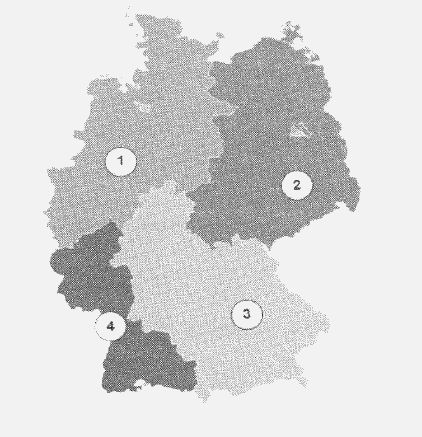
- a)1=Großbritannien, 2=Sowjetunion, 3=Frankreich, 4=USA
- b)1=Sowjetunion, 2=Großbritannien, 3=USA, 4=Frankreich
- c)1=Großbritannien, 2=Sowjetunion, 3=USA, 4=Frankreich
- d)1=Großbritannien, 2=USA, 3=Sowjetunion, 4=Frankreich
›Show answer
Correct answer: c) 1=Großbritannien, 2=Sowjetunion, 3=USA, 4=Frankreich
In English
How were the occupation zones of Germany distributed after 1945?
- a) 1=Great Britain, 2=Soviet Union, 3=France, 4=USA
- b) 1=Soviet Union, 2=Great Britain, 3=USA, 4=France
- c) 1=Great Britain, 2=Soviet Union, 3=USA, 4=France
- d) 1=Great Britain, 2=USA, 3=Soviet Union, 4=France
Explanation: On the map, zone 1 in the north-west is British, zone 2 in the east Soviet, the large zone 3 in the south American and the small zone 4 in the south-west French. The GDR was later founded in the Soviet zone in the east.
Question 177
Welche deutsche Stadt wurde nach dem Zweiten Weltkrieg in vier Sektoren aufgeteilt?
- a)München
- b)Berlin
- c)Dresden
- d)Frankfurt/Oder
›Show answer
Correct answer: b) Berlin
In English
Which German city was divided into four sectors after the Second World War?
- a) Munich
- b) Berlin
- c) Dresden
- d) Frankfurt (Oder)
Explanation: Although it lay inside the Soviet zone, Berlin was administered jointly by the four Allies and divided into four sectors. The three western sectors later formed West Berlin.
Question 178
Vom Juni 1948 bis zum Mai 1949 wurden die Bürger und Bürgerinnen von West-Berlin durch eine Luftbrücke versorgt. Welcher Umstand war dafür verantwortlich?
- a)Für Frankreich war eine Versorgung der West-Berliner Bevölkerung mit dem Flugzeug kostengünstiger.
- b)Die amerikanischen Soldaten / Soldatinnen hatten beim Landtransport Angst vor Überfällen.
- c)Für Großbritannien war die Versorgung über die Luftbrücke schneller.
- d)Die Sowjetunion unterbrach den gesamten Verkehr auf dem Landwege.
›Show answer
Correct answer: d) Die Sowjetunion unterbrach den gesamten Verkehr auf dem Landwege.
In English
From June 1948 to May 1949, the people of West Berlin were supplied by an airlift (Luftbrücke). What was the reason for this?
- a) For France it was cheaper to supply the people of West Berlin by plane.
- b) The American soldiers were afraid of attacks during land transport.
- c) For Great Britain, supplying the city via the airlift was faster.
- d) The Soviet Union cut off all traffic by land.
Explanation: In June 1948 the Soviet Union closed the land and water routes to West Berlin (the Berlin Blockade). The Western Allies, above all the USA and Great Britain, then supplied the city with food and coal by air for about a year.
Question 179
Wie endete der Zweite Weltkrieg in Europa offiziell?
- a)mit dem Tod Adolf Hitlers
- b)durch die bedingungslose Kapitulation Deutschlands
- c)mit dem Rückzug der Deutschen aus den besetzten Gebieten
- d)durch eine Revolution in Deutschland
›Show answer
Correct answer: b) durch die bedingungslose Kapitulation Deutschlands
In English
How did the Second World War officially end in Europe?
- a) with the death of Adolf Hitler
- b) through Germany's unconditional surrender
- c) with the withdrawal of the Germans from the occupied territories
- d) through a revolution in Germany
Explanation: The war officially ended with Germany's unconditional surrender, which took effect on 8 May 1945. Hitler had died on 30 April 1945, but his death did not end the war.
Question 180
Der erste Bundeskanzler der Bundesrepublik Deutschland war …
- a)Ludwig Erhard.
- b)Willy Brandt.
- c)Konrad Adenauer.
- d)Gerhard Schröder.
›Show answer
Correct answer: c) Konrad Adenauer.
In English
The first Federal Chancellor of the Federal Republic of Germany was …
- a) Ludwig Erhard.
- b) Willy Brandt.
- c) Konrad Adenauer.
- d) Gerhard Schröder.
Explanation: Konrad Adenauer (CDU) was the first Federal Chancellor of the Federal Republic, from 1949 to 1963. Ludwig Erhard succeeded him as the second chancellor; Willy Brandt and Gerhard Schröder held office later.
Question 181
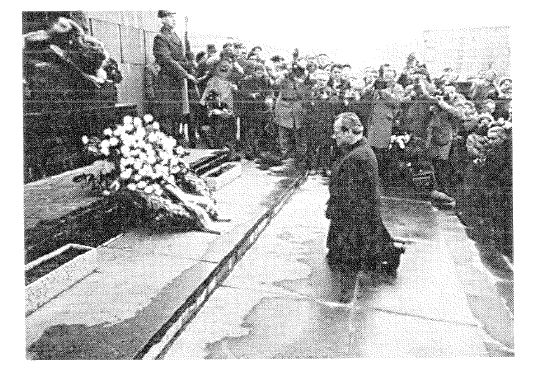
Was wollte Willy Brandt mit seinem Kniefall 1970 im ehemaligen jüdischen Ghetto in Warschau ausdrücken?
- a)Er hat sich den ehemaligen Alliierten unterworfen.
- b)Er bat Polen und die polnischen Juden um Vergebung.
- c)Er zeigte seine Demut vor dem Warschauer Pakt.
- d)Er sprach ein Gebet am Grab des Unbekannten Soldaten.
›Show answer
Correct answer: b) Er bat Polen und die polnischen Juden um Vergebung.
In English
What did Willy Brandt want to express by kneeling (Kniefall) in 1970 in the former Jewish ghetto in Warsaw?
- a) He submitted to the former Allies.
- b) He asked Poland and the Polish Jews for forgiveness.
- c) He showed his humility before the Warsaw Pact.
- d) He said a prayer at the Tomb of the Unknown Soldier.
Explanation: Federal Chancellor Willy Brandt knelt before the memorial to the Warsaw Ghetto Uprising, as the photo shows. The silent gesture was understood as a plea for forgiveness for the crimes Germans had committed in Poland and against the Jews.
Question 182
Wie heißt das jüdische Gebetshaus?
- a)Basilika
- b)Moschee
- c)Synagoge
- d)Kirche
›Show answer
Correct answer: c) Synagoge
In English
What is the Jewish house of prayer called?
- a) Basilica
- b) Mosque
- c) Synagogue
- d) Church
Explanation: Jews pray in a synagogue (Synagoge). A mosque is the house of prayer for Muslims, while a church and a basilica are Christian places of worship.
Question 183
Wann war in der Bundesrepublik Deutschland das „Wirtschaftswunder“?
- a)40er Jahre
- b)50er Jahre
- c)70er Jahre
- d)80er Jahre
›Show answer
Correct answer: b) 50er Jahre
In English
When was the ‘economic miracle’ (Wirtschaftswunder) in the Federal Republic of Germany?
- a) the 1940s
- b) the 1950s
- c) the 1970s
- d) the 1980s
Explanation: The ‘economic miracle’ describes the rapid economic recovery of the Federal Republic in the 1950s, after the Second World War. It is closely linked with Economics Minister Ludwig Erhard and the social market economy.
Question 184
Auf welcher rechtlichen Grundlage wurde der Staat Israel gegründet?
- a)eine Resolution der Vereinten Nationen
- b)ein Beschluss des Zionistenkongresses
- c)ein Vorschlag der Bundesregierung
- d)ein Vorschlag der UdSSR
›Show answer
Correct answer: a) eine Resolution der Vereinten Nationen
In English
On what legal basis was the State of Israel founded?
- a) a resolution of the United Nations
- b) a decision of the Zionist Congress
- c) a proposal by the Federal Government (Bundesregierung)
- d) a proposal by the USSR
Explanation: In 1947 the UN General Assembly adopted Resolution 181, which provided for dividing Palestine into a Jewish and an Arab state. The State of Israel was proclaimed on this basis in 1948.
Question 185
Wofür stand der Ausdruck „Eiserner Vorhang“? Für die Abschottung …
- a)des Warschauer Pakts gegen den Westen
- b)Norddeutschlands gegen Süddeutschland
- c)Nazi-Deutschlands gegen die Alliierten
- d)Europas gegen die USA
›Show answer
Correct answer: a) des Warschauer Pakts gegen den Westen
In English
What did the expression ‘Iron Curtain’ (Eiserner Vorhang) stand for? For the sealing-off of …
- a) the Warsaw Pact from the West
- b) Northern Germany from Southern Germany
- c) Nazi Germany from the Allies
- d) Europe from the USA
Explanation: The ‘Iron Curtain’ was the heavily guarded border that, during the Cold War, separated the Soviet-dominated Eastern Bloc (Warsaw Pact) from the West. The border dividing Germany was part of it.
Question 186
Im Jahr 1953 gab es in der DDR einen Aufstand, an den lange Zeit in der Bundesrepublik Deutschland ein Feiertag erinnerte. Wann war das?
- a)1. Mai
- b)17. Juni
- c)20. Juli
- d)9. November
›Show answer
Correct answer: b) 17. Juni
In English
In 1953 there was an uprising in the GDR which, for a long time, was commemorated by a public holiday in the Federal Republic of Germany. When was it?
- a) 1 May
- b) 17 June
- c) 20 July
- d) 9 November
Explanation: On 17 June 1953 there were strikes and a popular uprising in the GDR, which Soviet tanks put down. In the Federal Republic, 17 June was a public holiday called the ‘Day of German Unity’ until 1990; it was then replaced by 3 October.
Question 187
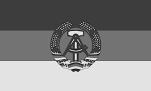
Welcher deutsche Staat hatte eine schwarz-rot-goldene Flagge mit Hammer, Zirkel und Ährenkranz?
- a)Preußen
- b)Bundesrepublik Deutschland
- c)„Drittes Reich“
- d)DDR
›Show answer
Correct answer: d) DDR
In English
Which German state had a black, red and gold flag with a hammer, a pair of compasses and a wreath of grain?
- a) Prussia (Preußen)
- b) the Federal Republic of Germany
- c) the ‘Third Reich’
- d) the GDR (East Germany)
Explanation: The flag of the GDR was black, red and gold with the state emblem in the middle: a hammer and a pair of compasses surrounded by a wreath of grain. The flag of the Federal Republic has the same colours but no emblem.
Question 188
In welchem Jahr wurde die Mauer in Berlin gebaut?
- a)1953
- b)1956
- c)1959
- d)1961
›Show answer
Correct answer: d) 1961
In English
In which year was the Wall in Berlin built?
- a) 1953
- b) 1956
- c) 1959
- d) 1961
Explanation: The GDR began building the Berlin Wall on 13 August 1961. Its aim was to stop people fleeing from East Germany to West Berlin.
Question 189
Wann baute die DDR die Mauer in Berlin?
- a)1919
- b)1933
- c)1961
- d)1990
›Show answer
Correct answer: c) 1961
In English
When did the GDR build the Wall in Berlin?
- a) 1919
- b) 1933
- c) 1961
- d) 1990
Explanation: The GDR built the Berlin Wall in August 1961, and it divided the city until 1989. 1990 is the year of reunification, not of the Wall's construction.
Question 190
Was bedeutet die Abkürzung DDR?
- a)Dritter Deutscher Rundfunk
- b)Die Deutsche Republik
- c)Dritte Deutsche Republik
- d)Deutsche Demokratische Republik
›Show answer
Correct answer: d) Deutsche Demokratische Republik
In English
What does the abbreviation DDR stand for?
- a) Third German Broadcasting (Dritter Deutscher Rundfunk)
- b) The German Republic (Die Deutsche Republik)
- c) Third German Republic (Dritte Deutsche Republik)
- d) German Democratic Republic (Deutsche Demokratische Republik)
Explanation: DDR is short for „Deutsche Demokratische Republik“, the German Democratic Republic (GDR), often called East Germany. This state existed from 1949 to 1990.
Question 191
Wann wurde die Mauer in Berlin für alle geöffnet?
- a)1987
- b)1989
- c)1992
- d)1995
›Show answer
Correct answer: b) 1989
In English
When was the Wall in Berlin opened to everyone?
- a) 1987
- b) 1989
- c) 1992
- d) 1995
Explanation: The Berlin Wall was opened on 9 November 1989, after peaceful mass protests in the GDR. Less than a year later, in 1990, Germany was reunified.
Question 192
Welches heutige deutsche Bundesland gehörte früher zum Gebiet der DDR?
- a)Brandenburg
- b)Bayern
- c)Saarland
- d)Hessen
›Show answer
Correct answer: a) Brandenburg
In English
Which of today's German federal states used to be part of the territory of the GDR?
- a) Brandenburg
- b) Bavaria (Bayern)
- c) Saarland
- d) Hesse (Hessen)
Explanation: Brandenburg is one of the five federal states on the territory of the former GDR; it surrounds Berlin. Bavaria, Saarland and Hesse belonged to the Federal Republic in the west.
Question 193
Von 1961 bis 1989 war Berlin …
- a)ohne Bürgermeister.
- b)ein eigener Staat.
- c)durch eine Mauer geteilt.
- d)nur mit dem Flugzeug erreichbar.
›Show answer
Correct answer: c) durch eine Mauer geteilt.
In English
From 1961 to 1989 Berlin was …
- a) without a mayor.
- b) a separate state.
- c) divided by a wall.
- d) only reachable by plane.
Explanation: In 1961 the GDR built a wall between the eastern and western parts of Berlin, which divided the city until it was opened in 1989. During this time West Berlin could still be reached by land on transit routes.
Question 194
Am 3. Oktober feiert man in Deutschland den Tag der Deutschen …
- a)Einheit.
- b)Nation.
- c)Bundesländer.
- d)Städte.
›Show answer
Correct answer: a) Einheit.
In English
On 3 October Germany celebrates the Day of German …
- a) Unity.
- b) Nation.
- c) Federal States.
- d) Cities.
Explanation: On 3 October 1990 the GDR joined the Federal Republic and Germany was reunified. That is why the Day of German Unity (Tag der Deutschen Einheit) is Germany's national holiday.
Question 195
Welches heutige deutsche Bundesland gehörte früher zum Gebiet der DDR?
- a)Hessen
- b)Sachsen-Anhalt
- c)Nordrhein-Westfalen
- d)Saarland
›Show answer
Correct answer: b) Sachsen-Anhalt
In English
Which of today's German federal states used to be part of the territory of the GDR?
- a) Hesse (Hessen)
- b) Saxony-Anhalt (Sachsen-Anhalt)
- c) North Rhine-Westphalia (Nordrhein-Westfalen)
- d) Saarland
Explanation: Saxony-Anhalt is one of the five federal states on the territory of the former GDR; its capital is Magdeburg. Hesse, North Rhine-Westphalia and Saarland belonged to the Federal Republic in the west.
Question 196
Warum nennt man die Zeit im Herbst 1989 in der DDR „Die Wende“? In dieser Zeit veränderte sich die DDR politisch …
- a)von einer Diktatur zur Demokratie.
- b)von einer liberalen Marktwirtschaft zum Sozialismus.
- c)von einer Monarchie zur Sozialdemokratie.
- d)von einem religiösen Staat zu einem kommunistischen Staat.
›Show answer
Correct answer: a) von einer Diktatur zur Demokratie.
In English
Why is the period in autumn 1989 in the GDR called „Die Wende“ (the turning point)? During this time the GDR changed politically …
- a) from a dictatorship to a democracy.
- b) from a liberal market economy to socialism.
- c) from a monarchy to social democracy.
- d) from a religious state to a communist state.
Explanation: In autumn 1989 peaceful mass protests in the GDR shook the SED dictatorship and the Berlin Wall was opened. After this turning point the first free elections were held in 1990 and the country became a democracy.
Question 197
Welches heutige deutsche Bundesland gehörte früher zum Gebiet der DDR?
- a)Thüringen
- b)Hessen
- c)Bayern
- d)Bremen
›Show answer
Correct answer: a) Thüringen
In English
Which of today's German federal states used to be part of the territory of the GDR?
- a) Thuringia (Thüringen)
- b) Hesse (Hessen)
- c) Bavaria (Bayern)
- d) Bremen
Explanation: Thuringia is one of the five federal states on the territory of the former GDR; its capital is Erfurt. Hesse, Bavaria and Bremen belonged to the Federal Republic in the west.
Question 198
Welches heutige deutsche Bundesland gehörte früher zum Gebiet der DDR?
- a)Bayern
- b)Niedersachsen
- c)Sachsen
- d)Baden-Württemberg
›Show answer
Correct answer: c) Sachsen
In English
Which of today's German federal states used to be part of the territory of the GDR?
- a) Bavaria (Bayern)
- b) Lower Saxony (Niedersachsen)
- c) Saxony (Sachsen)
- d) Baden-Württemberg
Explanation: Saxony is one of the five federal states on the territory of the former GDR; its capital is Dresden. Despite its similar name, Lower Saxony belonged to the Federal Republic in the west, as did Bavaria and Baden-Württemberg.
Question 199
Mit der Abkürzung „Stasi“ meinte man in der DDR …
- a)das Parlament.
- b)das Ministerium für Staatssicherheit.
- c)eine regierende Partei.
- d)das Ministerium für Volksbildung.
›Show answer
Correct answer: b) das Ministerium für Staatssicherheit.
In English
In the GDR, the abbreviation „Stasi“ referred to …
- a) the parliament.
- b) the Ministry for State Security (Ministerium für Staatssicherheit).
- c) a ruling party.
- d) the Ministry of Public Education (Ministerium für Volksbildung).
Explanation: „Stasi“ is short for the GDR's Ministry for State Security. As the secret service, it monitored the population and persecuted critics of the regime.
Question 200
Welches heutige deutsche Bundesland gehörte früher zum Gebiet der DDR?
- a)Hessen
- b)Schleswig-Holstein
- c)Mecklenburg-Vorpommern
- d)Saarland
›Show answer
Correct answer: c) Mecklenburg-Vorpommern
In English
Which of today's German federal states used to be part of the territory of the GDR?
- a) Hesse (Hessen)
- b) Schleswig-Holstein
- c) Mecklenburg-Vorpommern
- d) Saarland
Explanation: Mecklenburg-Western Pomerania is one of the five federal states on the territory of the former GDR; its capital is Schwerin. Schleswig-Holstein also lies on the Baltic coast, but like Hesse and Saarland it belonged to the Federal Republic.
Questions for your federal state
Each state's 10 questions with answers, translation and explanations on their own page.
- Baden-Württemberg
- Bavaria (Bayern)
- Berlin
- Brandenburg
- Bremen
- Hamburg
- Hesse (Hessen)
- Mecklenburg-Vorpommern
- Lower Saxony (Niedersachsen)
- North Rhine-Westphalia (Nordrhein-Westfalen)
- Rhineland-Palatinate (Rheinland-Pfalz)
- Saarland
- Saxony (Sachsen)
- Saxony-Anhalt (Sachsen-Anhalt)
- Schleswig-Holstein
- Thuringia (Thüringen)
Citizenship also requires B1 German
Besides this knowledge test, a citizenship application needs a German certificate at level B1 or higher (for example telc Deutsch B1, the DTZ or the Goethe-Zertifikat B1). Our guide explains which certificates are accepted, and the free placement test shows where you stand.