Leben in Deutschland test: questions 101–150 with answers
Questions 101 to 150 of the 300 general questions in the official catalogue, in catalogue order. Answer first, then reveal the correct answer, the English translation and an explanation. The practice tool covers all 310 questions and a 33-question mock test.
The test in brief
- 33 questions: 30 general questions and 3 questions about your federal state. Time: 60 minutes.
- Each question has four options and exactly one correct answer.
- For citizenship you need at least 17 correct answers.
- In the „Leben in Deutschland“ test of the integration course, 15 correct answers are enough for the certificate; 17 or more also count for a citizenship application.
Registration, fee, test centres and exemptions: our Leben in Deutschland test guide
Where do the questions and answers come from?
The German wording of the questions and options is taken unchanged from the official catalogue: Annex 1 of the Citizenship Test Ordinance (Einbürgerungstestverordnung). For the 5 questions whose content BAMF updated in its catalogue of 7 May 2025 (for example the question on the current chancellor) we use BAMF's wording. The images also come from the ordinance.
The catalogue does not mark the correct answers. We built the answer key from two independent solutions and then checked it against the answers in BAMF's online catalogue. The English translations and explanations are by Level Exams; in the test itself the questions are asked in German only.
Questions whose answer changes over time (the current chancellor, the parliamentary groups, population and similar) are marked and show the situation in November 2026. Level Exams is not affiliated with BAMF, telc gGmbH, ÖSD or the Goethe-Institut.
All 300 general questions with answers
The questions follow the order of the official catalogue. Answer first, then press „Show answer“ to see the correct option, an English translation and an explanation.
Questions 101–150
Question 101
Gewerkschaften sind Interessenverbände der …
- a)Jugendlichen.
- b)Arbeitnehmer und Arbeitnehmerinnen.
- c)Rentner und Renterinnen.
- d)Arbeitgeber und Arbeitgeberinnen.
›Show answer
Correct answer: b) Arbeitnehmer und Arbeitnehmerinnen.
In English
Trade unions are organisations representing the interests of …
- a) young people.
- b) employees.
- c) pensioners.
- d) employers.
Explanation: Trade unions (Gewerkschaften) represent employees, for example by negotiating pay and working conditions with employers in collective bargaining. Employers organise themselves in employers' associations.
Question 102
Womit kann man in der Bundesrepublik Deutschland geehrt werden, wenn man auf politischem, wirtschaftlichem, kulturellem, geistigem oder sozialem Gebiet eine besondere Leistung erbracht hat? Mit dem …
- a)Bundesverdienstkreuz
- b)Bundesadler
- c)Vaterländischen Verdienstorden
- d)Ehrentitel „Held der Deutschen Demokratischen Republik
›Show answer
Correct answer: a) Bundesverdienstkreuz
In English
In the Federal Republic of Germany, how can someone be honoured for an outstanding achievement in the political, economic, cultural, intellectual or social field? With the …
- a) Federal Cross of Merit (Bundesverdienstkreuz)
- b) Federal Eagle (Bundesadler)
- c) Patriotic Order of Merit (Vaterländischer Verdienstorden)
- d) honorary title “Hero of the German Democratic Republic”
Explanation: The Federal Cross of Merit (Bundesverdienstkreuz) is the Federal Republic's award for outstanding service to the community and is conferred by the Federal President. The Federal Eagle is the national coat of arms; the other two options were honours of the GDR.
Question 103
Was wird in Deutschland als „Ampelkoalition“ bezeichnet? Die Zusammenarbeit ...
- a)der Bundestagsfraktionen von CDU und CSU
- b)von SPD, FDP und Bündnis 90/Die Grünen in einer Regierung
- c)von CSU, Die Linke und Bündnis 90/Die Grünen in einer Regierung
- d)der Bundestagsfraktionen von CDU und SPD
›Show answer
Correct answer: b) von SPD, FDP und Bündnis 90/Die Grünen in einer Regierung
In English
What is called an „Ampelkoalition“ (traffic-light coalition) in Germany? The cooperation …
- a) of the Bundestag parliamentary groups of CDU and CSU
- b) of SPD, FDP and Bündnis 90/Die Grünen in a government
- c) of CSU, Die Linke and Bündnis 90/Die Grünen in a government
- d) of the Bundestag parliamentary groups of CDU and SPD
Explanation: The name comes from the party colours: red for the SPD, yellow for the FDP and green for the Greens (Bündnis 90/Die Grünen), like a traffic light. Such a coalition governed at federal level from 2021 to 2024.
Question 104
Eine Frau in Deutschland verliert ihre Arbeit. Was darf nicht der Grund für diese Entlassung sein?
- a)Die Frau ist lange krank und arbeitsunfähig.
- b)Die Frau kam oft zu spät zur Arbeit.
- c)Die Frau erledigt private Sachen während der Arbeitszeit.
- d)Die Frau bekommt ein Kind und ihr Chef weiß das.
›Show answer
Correct answer: d) Die Frau bekommt ein Kind und ihr Chef weiß das.
In English
A woman in Germany loses her job. What must not be the reason for this dismissal?
- a) The woman has been ill for a long time and is unable to work.
- b) The woman often came to work late.
- c) The woman does private things during working hours.
- d) The woman is expecting a baby and her boss knows this.
Explanation: Under the Maternity Protection Act (Mutterschutzgesetz), a pregnant woman generally cannot be dismissed during her pregnancy and for a certain period after the birth. Long illness, frequent lateness or doing private things during working hours can, under certain conditions, be grounds for dismissal.
Question 105
Was ist eine Aufgabe von Wahlhelfern / Wahlhelferinnen in Deutschland?
- a)Sie helfen alten Menschen bei der Stimmabgabe in der Wahlkabine.
- b)Sie schreiben die Wahlbenachrichtigungen vor der Wahl.
- c)Sie geben Zwischenergebnisse an die Medien weiter.
- d)Sie zählen die Stimmen nach dem Ende der Wahl.
›Show answer
Correct answer: d) Sie zählen die Stimmen nach dem Ende der Wahl.
In English
What is one of the tasks of poll workers (Wahlhelfer) in Germany?
- a) They help elderly people cast their vote in the voting booth.
- b) They write the polling cards before the election.
- c) They pass interim results on to the media.
- d) They count the votes after the polls close.
Explanation: Poll workers make sure voting runs properly at the polling station and count the votes once voting has ended. Because the ballot is secret, voters as a rule go into the booth alone, and polling cards are sent out by the municipality.
Question 106
In Deutschland helfen ehrenamtliche Wahlhelfer und Wahlhelferinnen bei den Wahlen. Was ist eine Aufgabe von Wahlhelfern / Wahlhelferinnen?
- a)Sie helfen Kindern und alten Menschen beim Wählen.
- b)Sie schreiben Karten und Briefe mit der Angabe des Wahllokals.
- c)Sie geben Zwischenergebnisse an Journalisten weiter.
- d)Sie zählen die Stimmen nach dem Ende der Wahl.
›Show answer
Correct answer: d) Sie zählen die Stimmen nach dem Ende der Wahl.
In English
In Germany, volunteer poll workers (Wahlhelfer) help at elections. What is one of the tasks of poll workers?
- a) They help children and elderly people to vote.
- b) They write cards and letters stating the polling station.
- c) They pass interim results on to journalists.
- d) They count the votes after the polls close.
Explanation: The main job of volunteer poll workers is to count the votes once voting has ended, and anyone may watch the count. Children cannot vote, the polling cards are sent by the municipality, and passing interim results to journalists is not part of the job.
Question 107
Für wie viele Jahre wird der Bundestag in Deutschland gewählt?
- a)2 Jahre
- b)4 Jahre
- c)6 Jahre
- d)8 Jahre
›Show answer
Correct answer: b) 4 Jahre
In English
For how many years is the Bundestag elected in Germany?
- a) 2 years
- b) 4 years
- c) 6 years
- d) 8 years
Explanation: Under Article 39 of the Basic Law, the Bundestag is elected for four years. Most state parliaments, by contrast, are elected for five years.
Question 108
Bei einer Bundestagswahl in Deutschland darf jeder wählen, der …
- a)in der Bundesrepublik Deutschland wohnt und wählen möchte.
- b)Bürger / Bürgerin der Bundesrepublik Deutschland ist und mindestens 18 Jahre alt ist.
- c)seit mindestens 3 Jahren in der Bundesrepublik Deutschland lebt.
- d)Bürger / Bürgerin der Bundesrepublik Deutschland ist und mindestens 21 Jahre alt ist.
›Show answer
Correct answer: b) Bürger / Bürgerin der Bundesrepublik Deutschland ist und mindestens 18 Jahre alt ist.
In English
In a Bundestag election in Germany, anyone may vote who …
- a) lives in the Federal Republic of Germany and wants to vote.
- b) is a citizen of the Federal Republic of Germany and is at least 18 years old.
- c) has lived in the Federal Republic of Germany for at least 3 years.
- d) is a citizen of the Federal Republic of Germany and is at least 21 years old.
Explanation: Anyone who is a German citizen and has reached the age of 18 may vote in a Bundestag election (Article 38 of the Basic Law). Living in Germany is not enough; EU citizens can only vote in local elections and in the European Parliament election.
Question 109
Wie oft gibt es normalerweise Bundestagswahlen in Deutschland?
- a)alle drei Jahre
- b)alle vier Jahre
- c)alle fünf Jahre
- d)alle sechs Jahre
›Show answer
Correct answer: b) alle vier Jahre
In English
How often are there normally Bundestag elections in Germany?
- a) every three years
- b) every four years
- c) every five years
- d) every six years
Explanation: The Bundestag is elected for four years, so elections normally take place every four years. If the Bundestag is dissolved early, an election can be held sooner, as happened in 2025.
Question 110
Für wie viele Jahre wird der Bundestag in Deutschland gewählt?
- a)2 Jahre
- b)3 Jahre
- c)4 Jahre
- d)5 Jahre
›Show answer
Correct answer: c) 4 Jahre
In English
For how many years is the Bundestag elected in Germany?
- a) 2 years
- b) 3 years
- c) 4 years
- d) 5 years
Explanation: The Bundestag's legislative term (Wahlperiode) is four years. Five years is the term of most state parliaments, which is why the two options are easily confused.
Question 111
Welche Handlungen mit Bezug auf den Staat Israel sind in Deutschland verboten?
- a)die Politik Israels öffentlich kritisieren
- b)das Aufhängen einer israelischen Flagge auf dem Privatgrundstück
- c)eine Diskussion über die Politik Israels
- d)der öffentliche Aufruf zur Vernichtung Israels
›Show answer
Correct answer: d) der öffentliche Aufruf zur Vernichtung Israels
In English
Which actions relating to the State of Israel are prohibited in Germany?
- a) publicly criticising Israel's policies
- b) hanging an Israeli flag on private property
- c) a discussion about Israel's policies
- d) publicly calling for the destruction of Israel
Explanation: Publicly calling for the destruction of Israel is a criminal offence and can be punished. Criticising or discussing Israel's policies is covered by freedom of expression, and hanging an Israeli flag on private property is allowed.
Question 112
Die Wahlen in Deutschland sind …
- a)speziell.
- b)geheim.
- c)berufsbezogen.
- d)geschlechtsabhängig.
›Show answer
Correct answer: b) geheim.
In English
Elections in Germany are …
- a) special.
- b) secret.
- c) occupation-related.
- d) gender-dependent.
Explanation: Under Article 38 of the Basic Law, elections are general, direct, free, equal and secret. A secret ballot means nobody else can find out how a person voted, which is why you mark your ballot paper alone in the booth.
Question 113
Wahlen in Deutschland gewinnt die Partei, die …
- a)die meisten Stimmen bekommt.
- b)die meisten Männer mehrheitlich gewählt haben.
- c)die meisten Stimmen bei den Arbeitern / Arbeiterinnen bekommen hat.
- d)die meisten Erststimmen für ihren Kanzlerkandidaten /ihre Kanzlerkandidatin erhalten hat.
›Show answer
Correct answer: a) die meisten Stimmen bekommt.
In English
Elections in Germany are won by the party that …
- a) receives the most votes.
- b) most men voted for.
- c) has received the most votes from workers.
- d) has received the most first votes (Erststimmen) for its candidate for Chancellor.
Explanation: The party with the most votes wins; every vote counts equally and votes are not counted separately by gender or occupation. The first vote is cast for a candidate in the local constituency, and the Chancellor is elected by the Bundestag.
Question 114
An demokratischen Wahlen in Deutschland teilzunehmen ist …
- a)eine Pflicht.
- b)ein Recht.
- c)ein Zwang.
- d)eine Last.
›Show answer
Correct answer: b) ein Recht.
In English
Taking part in democratic elections in Germany is …
- a) an obligation.
- b) a right.
- c) a compulsion.
- d) a burden.
Explanation: Voting in Germany is a right; there is no obligation to take part in elections. Because elections are free, nobody is penalised for not voting.
Question 115
Was bedeutet „aktives Wahlrecht“ in Deutschland?
- a)Man kann gewählt werden.
- b)Man muss wählen gehen.
- c)Man kann wählen.
- d)Man muss zur Auszählung der Stimmen gehen.
›Show answer
Correct answer: c) Man kann wählen.
In English
What does „aktives Wahlrecht“ (active electoral right) mean in Germany?
- a) You can be elected.
- b) You must go and vote.
- c) You can vote.
- d) You must go to the counting of the votes.
Explanation: The active electoral right is the right to vote. The right to stand for election is called the passive electoral right (passives Wahlrecht). There is no obligation to vote in Germany.
Question 116
Wenn Sie bei einer Bundestagswahl in Deutschland wählen dürfen, heißt das …
- a)aktive Wahlkampagne.
- b)aktives Wahlverfahren.
- c)aktiver Wahlkampf.
- d)aktives Wahlrecht.
›Show answer
Correct answer: d) aktives Wahlrecht.
In English
If you are allowed to vote in a Bundestag election in Germany, this is called …
- a) active election campaign (aktive Wahlkampagne).
- b) active electoral procedure (aktives Wahlverfahren).
- c) active electioneering (aktiver Wahlkampf).
- d) active electoral right (aktives Wahlrecht).
Explanation: The right to vote is called the active electoral right (aktives Wahlrecht). Wahlkampf and Wahlkampagne describe the parties' campaigning before an election, and Wahlverfahren refers to how an election is carried out.
Question 117
Wie viel Prozent der Zweitstimmen müssen Parteien mindestens bekommen, um in den Deutschen Bundestag gewählt zu werden?
- a)3 %
- b)4 %
- c)5 %
- d)6 %
›Show answer
Correct answer: c) 5 %
In English
What is the minimum percentage of second votes (Zweitstimmen) that parties must receive to be elected to the German Bundestag?
- a) 3 %
- b) 4 %
- c) 5 %
- d) 6 %
Explanation: As a rule, a party needs at least 5 per cent of the second votes to enter the Bundestag (the five per cent threshold). The threshold is meant to prevent parliament from splitting into many small parties; there are some exceptions, for example parties of national minorities are exempt from it.
Question 118
Wer darf bei den rund 40 jüdischen Makkabi-Sportvereinen Mitglied werden?
- a)nur Deutsche
- b)nur Israelis
- c)nur religiöse Menschen
- d)alle Menschen
›Show answer
Correct answer: d) alle Menschen
In English
Who may become a member of the roughly 40 Jewish Makkabi sports clubs?
- a) only Germans
- b) only Israelis
- c) only religious people
- d) everyone
Explanation: Makkabi sports clubs are Jewish clubs, but they are open to everyone, regardless of religion or background. In this way they bring different people together through sport.
Question 119
Wahlen in Deutschland sind frei. Was bedeutet das?
- a)Alle verurteilten Straftäter / Straftäterinnen dürfen nicht wählen.
- b)Wenn ich wählen gehen möchte, muss mein Arbeitgeber / meine Arbeitgeberin mir frei geben.
- c)Jede Person kann ohne Zwang entscheiden, ob sie wählen möchte und wen sie wählen möchte.
- d)Ich kann frei entscheiden, wo ich wählen gehen möchte.
›Show answer
Correct answer: c) Jede Person kann ohne Zwang entscheiden, ob sie wählen möchte und wen sie wählen möchte.
In English
Elections in Germany are free. What does this mean?
- a) All convicted offenders are not allowed to vote.
- b) If I want to go and vote, my employer must give me time off.
- c) Every person can decide without coercion whether they want to vote and whom they want to vote for.
- d) I can freely decide where I go to vote.
Explanation: Free elections mean that nobody can be forced to vote or to vote for a particular party. You cannot choose your polling station freely, as it depends on where you live, but postal voting is possible.
Question 120
Das Wahlsystem in Deutschland ist ein …
- a)Zensuswahlrecht.
- b)Dreiklassenwahlrecht.
- c)Mehrheits- und Verhältniswahlrecht.
- d)allgemeines Männerwahlrecht.
›Show answer
Correct answer: c) Mehrheits- und Verhältniswahlrecht.
In English
The electoral system in Germany is …
- a) a census franchise (Zensuswahlrecht).
- b) a three-class franchise (Dreiklassenwahlrecht).
- c) a majority and proportional system (Mehrheits- und Verhältniswahlrecht).
- d) a general male franchise (allgemeines Männerwahlrecht).
Explanation: Germany combines majority and proportional voting: the first vote is cast for a candidate in the constituency, the second vote for a party, and the seats are distributed according to the second votes. Census and three-class franchises belong to the past, and women have had the vote since 1918.
Question 121
Eine Partei möchte in den Deutschen Bundestag. Sie muss aber einen Mindestanteil an Wählerstimmen haben. Das heißt …
- a)5 %-Hürde.
- b)Zulassungsgrenze.
- c)Basiswert.
- d)Richtlinie.
›Show answer
Correct answer: a) 5 %-Hürde.
In English
A party wants to enter the German Bundestag. However, it must reach a minimum share of the votes. This is called …
- a) the 5 % hurdle (5 %-Hürde).
- b) the admission limit (Zulassungsgrenze).
- c) the base value (Basiswert).
- d) the guideline (Richtlinie).
Explanation: To enter the Bundestag, a party must win at least 5 % of the second votes (Zweitstimmen); this rule is called the 5 % hurdle. As a rule, a party below this threshold is left out of the distribution of seats.
Question 122
Welchem Grundsatz unterliegen Wahlen in Deutschland? Wahlen in Deutschland sind …
- a)frei, gleich, geheim.
- b)offen, sicher, frei.
- c)geschlossen, gleich, sicher.
- d)sicher, offen, freiwillig.
›Show answer
Correct answer: a) frei, gleich, geheim.
In English
Which principle do elections in Germany follow? Elections in Germany are …
- a) free, equal, secret.
- b) open, safe, free.
- c) closed, equal, safe.
- d) safe, open, voluntary.
Explanation: Under Article 38 of the Basic Law, Bundestag elections are general, direct, free, equal and secret. Because the vote is cast in secret, the options containing ‘open’ are wrong.
Question 123
Was ist in Deutschland die „5 %-Hürde“?
- a)Abstimmungsregelung im Bundestag für kleine Parteien
- b)Anwesenheitskontrolle im Bundestag für Abstimmungen
- c)Mindestanteil an Wählerstimmen, um ins Parlament zu kommen
- d)Anwesenheitskontrolle im Bundesrat für Abstimmungen
›Show answer
Correct answer: c) Mindestanteil an Wählerstimmen, um ins Parlament zu kommen
In English
What is the ‘5 % hurdle’ (5 %-Hürde) in Germany?
- a) a voting rule in the Bundestag for small parties
- b) an attendance check in the Bundestag for votes
- c) the minimum share of votes needed to enter parliament
- d) an attendance check in the Bundesrat for votes
Explanation: As a rule, a party needs at least 5 % of the second votes to enter the Bundestag; this minimum share is called the 5 % hurdle. It has nothing to do with voting procedures or attendance in parliament.
Question 124
Die Bundestagswahl in Deutschland ist die Wahl …
- a)des Bundeskanzlers / der Bundeskanzlerin.
- b)der Parlamente der Länder.
- c)des Parlaments für Deutschland.
- d)des Bundespräsidenten / der Bundespräsidentin.
›Show answer
Correct answer: c) des Parlaments für Deutschland.
In English
The Bundestag election in Germany is the election of …
- a) the Federal Chancellor.
- b) the parliaments of the federal states.
- c) the parliament for Germany.
- d) the Federal President.
Explanation: In the Bundestag election, citizens elect Germany's federal parliament, the Bundestag. The Federal Chancellor is elected by the Bundestag and the Federal President by the Federal Convention (Bundesversammlung); state parliaments are chosen in state elections.
Question 125
In einer Demokratie ist eine Funktion von regelmäßigen Wahlen, …
- a)die Bürger und Bürgerinnen zu zwingen, ihre Stimme abzugeben.
- b)nach dem Willen der Wählermehrheit den Wechsel der Regierung zu ermöglichen.
- c)im Land bestehende Gesetze beizubehalten.
- d)den Armen mehr Macht zu geben.
›Show answer
Correct answer: b) nach dem Willen der Wählermehrheit den Wechsel der Regierung zu ermöglichen.
In English
In a democracy, one function of regular elections is …
- a) to force citizens to cast their vote.
- b) to make a change of government possible according to the will of the majority of voters.
- c) to keep the laws that exist in the country.
- d) to give the poor more power.
Explanation: Regular elections let the people decide again at fixed intervals who holds power, so the government can change peacefully if the majority wants it. There is no compulsory voting in Germany, and elections are not held to preserve existing laws.
Question 126
Was bekommen wahlberechtigte Bürger und Bürgerinnen in Deutschland vor einer Wahl?
- a)eine Wahlbenachrichtigung von der Gemeinde
- b)eine Wahlerlaubnis vom Bundespräsidenten / von der Bundespräsidentin
- c)eine Benachrichtigung von der Bundesversammlung
- d)eine Benachrichtigung vom Pfarramt
›Show answer
Correct answer: a) eine Wahlbenachrichtigung von der Gemeinde
In English
What do citizens who are entitled to vote in Germany receive before an election?
- a) a polling card from the municipality
- b) a permit to vote from the Federal President
- c) a notification from the Federal Convention (Bundesversammlung)
- d) a notification from the parish office (Pfarramt)
Explanation: A few weeks before an election, the municipality sends everyone on the electoral register a polling card (Wahlbenachrichtigung). It states the election date and the polling station, and it can also be used to apply for a postal vote (Briefwahl).
Question 127
Warum gibt es die 5 %-Hürde im Wahlgesetz der Bundesrepublik Deutschland? Es gibt sie, weil …
- a)die Programme von vielen kleinen Parteien viele Gemeinsamkeiten haben.
- b)die Bürger und Bürgerinnen bei vielen kleinen Parteien die Orientierung verlieren können.
- c)viele kleine Parteien die Regierungsbildung erschweren.
- d)die kleinen Parteien nicht so viel Geld haben, um die Politiker und Politikerinnen zu bezahlen.
›Show answer
Correct answer: c) viele kleine Parteien die Regierungsbildung erschweren.
In English
Why is there a 5 % hurdle in the electoral law of the Federal Republic of Germany? It exists because …
- a) the programmes of many small parties have a lot in common.
- b) citizens can lose their bearings when there are many small parties.
- c) many small parties make it harder to form a government.
- d) small parties do not have enough money to pay their politicians.
Explanation: If many small parties sit in parliament, it becomes harder to find a stable majority and form a government. The fragmented parliament of the Weimar Republic is one of the experiences behind this rule.
Question 128
Parlamentsmitglieder, die von den Bürgern und Bürgerinnen gewählt werden, nennt man …
- a)Abgeordnete.
- b)Kanzler / Kanzlerinnen.
- c)Botschafter / Botschafterinnen.
- d)Ministerpräsidenten / Ministerpräsidentinnen.
›Show answer
Correct answer: a) Abgeordnete.
In English
People who are elected by the citizens to sit in a parliament are called …
- a) members of parliament (Abgeordnete).
- b) chancellors (Kanzler).
- c) ambassadors (Botschafter).
- d) Minister-Presidents (Ministerpräsidenten).
Explanation: Members of parliament elected by the people are called Abgeordnete, for example the members of the Bundestag and of the state parliaments. Chancellors and Minister-Presidents are not elected directly by the people but by parliament.
Question 129
Vom Volk gewählt wird in Deutschland …
- a)der Bundeskanzler / die Bundeskanzlerin.
- b)der Ministerpräsident / die Ministerpräsidentin eines Bundeslandes.
- c)der Bundestag.
- d)der Bundespräsident / die Bundespräsidentin.
›Show answer
Correct answer: c) der Bundestag.
In English
In Germany, the people elect …
- a) the Federal Chancellor.
- b) the Minister-President of a federal state.
- c) the Bundestag.
- d) the Federal President.
Explanation: The people directly elect only the Bundestag. The Federal Chancellor is elected by the Bundestag, the Federal President by the Federal Convention (Bundesversammlung) and a Minister-President by the state parliament (Landtag).
Question 130
Welcher Stimmzettel wäre bei einer Bundestagswahl gültig?
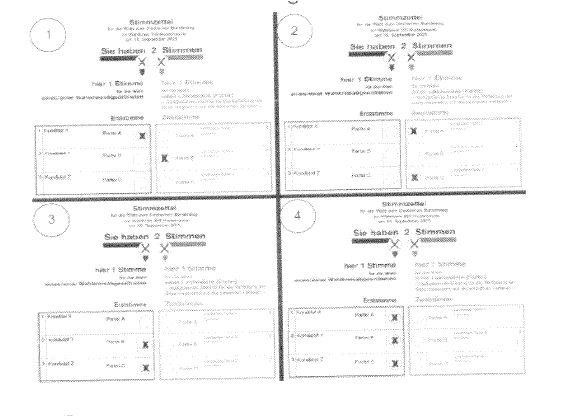
- a)1
- b)2
- c)3
- d)4
›Show answer
Correct answer: a) Option 1
In English
Which ballot paper would be valid in a Bundestag election?
Explanation: In a Bundestag election each voter has two votes: the first vote (Erststimme) for a candidate and the second vote (Zweitstimme) for a party. Ballot 1 has exactly one cross in each column; ballot 2 has two crosses for the second vote and ballots 3 and 4 several crosses for the first vote, so that vote is invalid.
Question 131
In Deutschland ist ein Bürgermeister / eine Bürgermeisterin …
- a)der Leiter / die Leiterin einer Schule.
- b)der Chef / die Chefin einer Bank.
- c)das Oberhaupt einer Gemeinde.
- d)der / die Vorsitzende einer Partei.
›Show answer
Correct answer: c) das Oberhaupt einer Gemeinde.
In English
In Germany, a mayor (Bürgermeister) is …
- a) the head teacher of a school.
- b) the boss of a bank.
- c) the head of a municipality.
- d) the chair of a party.
Explanation: A mayor (Bürgermeister) is the head of a town or city, i.e. a municipality, and leads its administration. Running a school, a bank or a party are different roles.
Question 132
Viele Menschen in Deutschland arbeiten in ihrer Freizeit ehrenamtlich. Was bedeutet das?
- a)Sie arbeiten als Soldaten / Soldatinnen.
- b)Sie arbeiten freiwillig und unbezahlt in Vereinen und Verbänden.
- c)Sie arbeiten in der Bundesregierung.
- d)Sie arbeiten in einem Krankenhaus und verdienen dabei Geld.
›Show answer
Correct answer: b) Sie arbeiten freiwillig und unbezahlt in Vereinen und Verbänden.
In English
Many people in Germany work in an honorary capacity (ehrenamtlich) in their free time. What does that mean?
- a) They work as soldiers.
- b) They work voluntarily and without pay in clubs and associations.
- c) They work in the Federal Government.
- d) They work in a hospital and earn money doing so.
Explanation: „Ehrenamt“ means voluntary work done without pay, for example in sports clubs, volunteer fire brigades or charities. Such work is an important part of social life in Germany.
Question 133
Was ist bei Bundestags- und Landtagswahlen in Deutschland erlaubt?
- a)Der Ehemann wählt für seine Frau mit.
- b)Man kann durch Briefwahl seine Stimme abgeben.
- c)Man kann am Wahltag telefonisch seine Stimme abgeben.
- d)Kinder ab dem Alter von 14 Jahren dürfen wählen.
›Show answer
Correct answer: b) Man kann durch Briefwahl seine Stimme abgeben.
In English
What is allowed in Bundestag and state parliament elections in Germany?
- a) A husband also votes on behalf of his wife.
- b) You can cast your vote by postal vote.
- c) You can cast your vote by telephone on election day.
- d) Children aged 14 and over may vote.
Explanation: Instead of going to the polling station on election day, voters can also vote by post (Briefwahl), which they request from their municipality. Voting is personal, so nobody may vote for someone else; voting by telephone is not possible and 14-year-olds have no right to vote.
Question 134
Man will die Buslinie abschaffen, mit der Sie immer zur Arbeit fahren. Was können Sie machen, um die Buslinie zu erhalten?
- a)Ich beteilige mich an einer Bürgerinitiative für die Erhaltung der Buslinie oder gründe selber eine Initiative.
- b)Ich werde Mitglied in einem Sportverein und trainiere Rad fahren.
- c)Ich wende mich an das Finanzamt, weil ich als Steuerzahler / Steuerzahlerin ein Recht auf die Buslinie habe.
- d)Ich schreibe einen Brief an das Forstamt der Gemeinde.
›Show answer
Correct answer: a) Ich beteilige mich an einer Bürgerinitiative für die Erhaltung der Buslinie oder gründe selber eine Initiative.
In English
There are plans to scrap the bus route you always take to work. What can you do to keep the bus route?
- a) I join a citizens' initiative (Bürgerinitiative) to keep the bus route or set up an initiative myself.
- b) I join a sports club and train in cycling.
- c) I contact the tax office (Finanzamt), because as a taxpayer I have a right to the bus route.
- d) I write a letter to the municipality's forestry office (Forstamt).
Explanation: A citizens' initiative (Bürgerinitiative) is a group of citizens who come together over a specific local issue and try to influence decisions, for example by collecting signatures or talking to the municipality. The tax office and the forestry office are not responsible for bus routes.
Question 135
Wen vertreten die Gewerkschaften in Deutschland?
- a)große Unternehmen
- b)kleine Unternehmen
- c)Selbstständige
- d)Arbeitnehmer und Arbeitnehmerinnen
›Show answer
Correct answer: d) Arbeitnehmer und Arbeitnehmerinnen
In English
Whom do trade unions represent in Germany?
- a) large companies
- b) small companies
- c) the self-employed
- d) employees
Explanation: Trade unions (Gewerkschaften) represent employees' interests, for example by negotiating collective agreements on pay and working conditions with employers. Companies' interests are represented by employers' associations.
Question 136
Sie gehen in Deutschland zum Arbeitsgericht bei …
- a)falscher Nebenkostenabrechnung.
- b)ungerechtfertigter Kündigung durch Ihren Chef / Ihre Chefin.
- c)Problemen mit den Nachbarn / Nachbarinnen.
- d)Schwierigkeiten nach einem Verkehrsunfall.
›Show answer
Correct answer: b) ungerechtfertigter Kündigung durch Ihren Chef / Ihre Chefin.
In English
In Germany you go to the labour court (Arbeitsgericht) in the case of …
- a) an incorrect service charge statement (Nebenkostenabrechnung).
- b) unjustified dismissal by your boss.
- c) problems with your neighbours.
- d) difficulties after a road accident.
Explanation: The labour court deals with disputes between employees and employers, and unjustified dismissal is a typical example. Rental issues such as service charges, or disputes with neighbours, usually go to the local court (Amtsgericht).
Question 137
Welches Gericht ist in Deutschland bei Konflikten in der Arbeitswelt zuständig?
- a)das Familiengericht
- b)das Strafgericht
- c)das Arbeitsgericht
- d)das Amtsgericht
›Show answer
Correct answer: c) das Arbeitsgericht
In English
Which court is responsible in Germany for conflicts in the world of work?
- a) the family court (Familiengericht)
- b) the criminal court (Strafgericht)
- c) the labour court (Arbeitsgericht)
- d) the local court (Amtsgericht)
Explanation: Disputes between employees and employers, for example about pay or dismissal, are heard by the labour court. The family court deals with matters such as divorce and custody, and the criminal court with crimes.
Question 138
Was kann ich in Deutschland machen, wenn mir mein Arbeitgeber / meine Arbeitgeberin zu Unrecht gekündigt hat?
- a)weiter arbeiten und freundlich zum Chef / zur Chefin sein
- b)ein Mahnverfahren gegen den Arbeitgeber / die Arbeitgeberin führen
- c)Kündigungsschutzklage erheben
- d)den Arbeitgeber / die Arbeitgeberin bei der Polizei anzeigen
›Show answer
Correct answer: c) Kündigungsschutzklage erheben
In English
What can I do in Germany if my employer has dismissed me unfairly?
- a) keep working and be friendly to my boss
- b) start a debt collection procedure (Mahnverfahren) against the employer
- c) file an unfair dismissal claim (Kündigungsschutzklage)
- d) report the employer to the police
Explanation: Against an unfair dismissal you can file an unfair dismissal claim at the labour court; it must be filed within three weeks of receiving the notice. The Mahnverfahren is for collecting money, and the police deal with criminal offences.
Question 139
Wann kommt es in Deutschland zu einem Prozess vor Gericht? Wenn jemand …
- a)zu einer anderen Religion übertritt.
- b)eine Straftat begangen hat und angeklagt wird.
- c)eine andere Meinung als die der Regierung vertritt.
- d)sein Auto falsch geparkt hat und es abgeschleppt wird.
›Show answer
Correct answer: b) eine Straftat begangen hat und angeklagt wird.
In English
When does a trial take place in court in Germany? When someone …
- a) converts to another religion.
- b) has committed a criminal offence and is charged.
- c) holds an opinion different from the government's.
- d) has parked his or her car illegally and it is towed away.
Explanation: If the public prosecutor charges someone who has committed a criminal offence, the case is tried in court. Changing religion and disagreeing with the government are protected fundamental rights; wrong parking usually leads to a fine and towing, not a trial.
Question 140
Was macht ein Schöffe / eine Schöffin in Deutschland? Er / Sie …
- a)entscheidet mit Richtern / Richterinnen über Schuld und Strafe.
- b)gibt Bürgern / Bürgerinnen rechtlichen Rat.
- c)stellt Urkunden aus.
- d)verteidigt den Angeklagten / die Angeklagte.
›Show answer
Correct answer: a) entscheidet mit Richtern / Richterinnen über Schuld und Strafe.
In English
What does a „Schöffe“ do in Germany? He or she …
- a) decides on guilt and punishment together with judges.
- b) gives citizens legal advice.
- c) issues official documents.
- d) defends the accused.
Explanation: A Schöffe is a lay judge who serves in criminal cases in an honorary capacity alongside professional judges and decides with them on guilt and sentence. Giving legal advice and defending the accused is the work of a lawyer.
Question 141
Wer berät in Deutschland Personen bei Rechtsfragen und vertritt sie vor Gericht?
- a)ein Rechtsanwalt / eine Rechtsanwältin
- b)ein Richter / eine Richterin
- c)ein Schöffe / eine Schöffin
- d)ein Staatsanwalt / eine Staatsanwältin
›Show answer
Correct answer: a) ein Rechtsanwalt / eine Rechtsanwältin
In English
Who advises people on legal matters in Germany and represents them in court?
- a) a lawyer (Rechtsanwalt)
- b) a judge (Richter)
- c) a lay judge (Schöffe)
- d) a public prosecutor (Staatsanwalt)
Explanation: A lawyer (Rechtsanwalt) gives clients legal advice and represents them in court. Judges and lay judges decide cases, while the public prosecutor prosecutes crimes on behalf of the state.
Question 142
Was ist die Hauptaufgabe eines Richters / einer Richterin in Deutschland? Ein Richter / eine Richterin …
- a)vertritt Bürger und Bürgerinnen vor einem Gericht.
- b)arbeitet an einem Gericht und spricht Urteile.
- c)ändert Gesetze.
- d)betreut Jugendliche vor Gericht.
›Show answer
Correct answer: b) arbeitet an einem Gericht und spricht Urteile.
In English
What is the main task of a judge in Germany? A judge …
- a) represents citizens in court.
- b) works at a court and delivers judgments.
- c) changes laws.
- d) looks after young people in court.
Explanation: Judges hear cases at court and deliver judgments; they are independent and subject only to the law (Article 97 of the Basic Law). Representing citizens is a lawyer's job, and changing laws is the job of parliament.
Question 143
Ein Richter / eine Richterin in Deutschland gehört zur …
- a)Judikative.
- b)Exekutive.
- c)Operative.
- d)Legislative.
›Show answer
Correct answer: a) Judikative.
In English
In Germany, a judge belongs to …
- a) the judiciary (Judikative).
- b) the executive (Exekutive).
- c) the operative branch (Operative).
- d) the legislature (Legislative).
Explanation: State power in Germany is divided into three branches: the legislature, the executive and the judiciary. Judges decide cases in court, so they belong to the judiciary; there is no ‘operative’ branch of state power.
Question 144
Ein Richter / eine Richterin gehört in Deutschland zur …
- a)vollziehenden Gewalt.
- b)rechtsprechenden Gewalt.
- c)planenden Gewalt.
- d)gesetzgebenden Gewalt.
›Show answer
Correct answer: b) rechtsprechenden Gewalt.
In English
In Germany, a judge belongs to …
- a) the executive power (vollziehende Gewalt).
- b) the judicial power (rechtsprechende Gewalt).
- c) the planning power (planende Gewalt).
- d) the legislative power (gesetzgebende Gewalt).
Explanation: Judges administer justice (Recht sprechen), so they belong to the judicial power. Parliament makes the laws (legislative power), and the government and administration carry them out (executive power); there is no ‘planning power’.
Question 145
In Deutschland wird die Staatsgewalt geteilt. Für welche Staatsgewalt arbeitet ein Richter / eine Richterin? Für die …
- a)Judikative
- b)Exekutive
- c)Presse
- d)Legislative
›Show answer
Correct answer: a) Judikative
In English
In Germany, state power is divided. Which branch of state power does a judge work for? For the …
- a) judiciary (Judikative)
- b) executive (Exekutive)
- c) press (Presse)
- d) legislature (Legislative)
Explanation: Under the separation of powers, the legislature makes laws, the executive carries them out and the judiciary decides cases in court; judges belong to the judiciary. The press plays an important watchdog role but is not a branch of state power.
Question 146
Wie nennt man in Deutschland ein Verfahren vor einem Gericht?
- a)Programm
- b)Prozedur
- c)Protokoll
- d)Prozess
›Show answer
Correct answer: d) Prozess
In English
What are proceedings before a court called in Germany?
- a) programme (Programm)
- b) procedure (Prozedur)
- c) minutes (Protokoll)
- d) trial (Prozess)
Explanation: In German, a case heard before a court is called a „Prozess“, for example a „Strafprozess“ (criminal trial). A „Protokoll“ is the written record kept during a hearing.
Question 147
Was ist die Arbeit eines Richters / einer Richterin in Deutschland?
- a)Deutschland regieren
- b)Recht sprechen
- c)Pläne erstellen
- d)Gesetze erlassen
›Show answer
Correct answer: b) Recht sprechen
In English
What is the work of a judge in Germany?
- a) governing Germany
- b) administering justice
- c) drawing up plans
- d) passing laws
Explanation: Judges hear cases in court and decide them according to the law, which in German is called „Recht sprechen“. Governing the country is the government's job, and passing laws is parliament's.
Question 148
Was ist eine Aufgabe der Polizei in Deutschland?
- a)das Land zu verteidigen
- b)die Bürgerinnen und Bürger abzuhören
- c)die Gesetze zu beschließen
- d)die Einhaltung von Gesetzen zu überwachen
›Show answer
Correct answer: d) die Einhaltung von Gesetzen zu überwachen
In English
What is one of the tasks of the police in Germany?
- a) to defend the country
- b) to eavesdrop on citizens
- c) to pass the laws
- d) to monitor compliance with the laws
Explanation: The police monitor compliance with the laws, prevent dangers and investigate crimes. Defending the country is the task of the armed forces (Bundeswehr), passing laws is the task of parliament, and eavesdropping on citizens is not a general police task.
Question 149
Was ist ein Beispiel für antisemitisches Verhalten?
- a)ein jüdisches Fest besuchen
- b)die israelische Regierung kritisieren
- c)den Holocaust leugnen
- d)gegen Juden Fußball spielen
›Show answer
Correct answer: c) den Holocaust leugnen
In English
What is an example of antisemitic behaviour?
- a) visiting a Jewish festival
- b) criticising the Israeli government
- c) denying the Holocaust
- d) playing football against Jews
Explanation: Denying the Holocaust, the systematic murder of Europe's Jews by the National Socialists, is antisemitic and a criminal offence in Germany. Criticising the policies of the Israeli government is not in itself antisemitic, and playing football against Jewish players is an ordinary match.
Question 150
Ein Gerichtsschöffe / eine Gerichtsschöffin in Deutschland ist …
- a)der Stellvertreter / die Stellvertreterin des Stadtoberhaupts.
- b)ein ehrenamtlicher Richter / eine ehrenamtliche Richterin.
- c)ein Mitglied eines Gemeinderats.
- d)eine Person, die Jura studiert hat.
›Show answer
Correct answer: b) ein ehrenamtlicher Richter / eine ehrenamtliche Richterin.
In English
In Germany, a „Gerichtsschöffe“ is …
- a) the deputy of the head of the town.
- b) an honorary judge.
- c) a member of a municipal council.
- d) a person who has studied law.
Explanation: A Schöffe is an honorary judge who decides criminal cases together with professional judges. He or she does not need legal training and is chosen from among the citizens, so ordinary people take part in the administration of justice.
Questions for your federal state
Each state's 10 questions with answers, translation and explanations on their own page.
- Baden-Württemberg
- Bavaria (Bayern)
- Berlin
- Brandenburg
- Bremen
- Hamburg
- Hesse (Hessen)
- Mecklenburg-Vorpommern
- Lower Saxony (Niedersachsen)
- North Rhine-Westphalia (Nordrhein-Westfalen)
- Rhineland-Palatinate (Rheinland-Pfalz)
- Saarland
- Saxony (Sachsen)
- Saxony-Anhalt (Sachsen-Anhalt)
- Schleswig-Holstein
- Thuringia (Thüringen)
Citizenship also requires B1 German
Besides this knowledge test, a citizenship application needs a German certificate at level B1 or higher (for example telc Deutsch B1, the DTZ or the Goethe-Zertifikat B1). Our guide explains which certificates are accepted, and the free placement test shows where you stand.