levelexams
C1

Экзамен ÖSD Zertifikat C1 и онлайн-пробный тест

Австрийский сертификат уровня C1, которого ждут в академической работе и на квалифицированных должностях. Тренируйтесь на пробных экзаменах с таймером, построенных на собственных заданиях, минимумах и официальных критериях оценки ÖSD.

Пройти мини-тест без регистрации

В системе Австрийского языкового диплома по немецкому языку (Österreichisches Sprachdiplom Deutsch, ÖSD) Zertifikat C1 подтверждает уровень C1 по общеевропейской шкале (CEFR). На этом уровне речь уже не о том, чтобы справиться, а о точности: видеть, что насыщенная статья подразумевает между строк, подробно следить за длинной радиопередачей или лекцией, отвечать учреждению в подходящем регистре и представлять тему вместе с собственным мнением. ÖSD входит в ALTE.

Экзамен состоит из письменного и устного модулей. Письменный модуль охватывает чтение, аудирование и письмо; преодолеть его порог недостаточно, потому что каждый из этих навыков должен ещё и оставаться выше собственного минимума. Кандидат, опустившийся ниже одного из них, не сдаёт весь письменный модуль. Устный модуль индивидуальный: напротив вас сидит экзаменатор, а не другой кандидат.

На уровне C1 у Goethe, telc и ÖSD нет общего экзамена; ÖSD Zertifikat C1 — формат ÖSD от начала до конца. В последнем задании на чтение вы сами вписываете пропущенное слово, в аудировании дополняете заметки, слушая лекцию, а у свободного письменного задания есть минимальный объём. Привыкнуть к этим деталям помогают только пробники в формате ÖSD.

Кому он нужен

Университет и академическая работа

Для академических должностей, например в исследованиях и преподавании, часто нужен немецкий на уровне C1. Но о зачислении решает университет: в Германии чаще всего требуют TestDaF, DSH, telc C1 Hochschule и Goethe C2. Проверьте языковые требования своего университета, чтобы понять, достаточно ли ÖSD C1 для вашей программы.

Квалифицированная работа и руководящие должности

В управлении, образовании и профессиях, связанных с языком, работодатели часто ожидают C1. Для вида на жительство, гражданства и признания квалификации в Германии сертификат ÖSD засчитывается так же, как сертификаты Goethe и telc; если в вакансии настаивают на определённом сертификате, спросите работодателя.

Жизнь и работа в Австрии

ÖSD — собственный австрийский диплом, и в его текстах может встречаться австрийская лексика. Для заявления там уточните в учреждении, какой сертификат и какой уровень требуются.

Структура экзамена

В таблице показана структура пробных экзаменов ÖSD C1 на Level Exams; она сверена с Modellsatz ÖSD для общего C1, правилами проведения экзамена (Durchführungsbestimmungen) и листами оценки. Письменный модуль идёт в порядке чтение, аудирование, письмо. Устный модуль идёт последним, на официальном экзамене может проходить в другой день и начинается со времени на подготовку.

РазделВремяБаллыЗадания
Leseverstehen
Чтение
90 мин20 баллов
  • Teil 1 · Detailverstehen (langer Sachtext) · 5 заданий · выбор ответа
  • Teil 2 · Globalverstehen (Überschriften zuordnen) · 5 заданий · сопоставление
  • Teil 3 · Textrekonstruktion (Abschnitte einfügen) · 5 заданий · сопоставление
  • Teil 4 · Lückentext (ein Wort pro Lücke) · 15 заданий · заполнение пропусков (список слов)
Hörverstehen
Аудирование
40 мин20 баллов
  • Teil 1 · Radiosendung · 10 заданий · выбор ответа · звучит 2 раза
  • Teil 2 · Vortrag (Notizen ergänzen) · 10 заданий · заполнение пропусков (список слов) · звучит 2 раза
Schriftlicher Ausdruck
Письмо
90 мин30 баллов
  • Teil 1 · Formeller Text (Antwortschreiben) · 1 задание · свободное письмо
  • Teil 2 · Freie Textproduktion (Thema A, B oder C) · 1 задание · свободное письмо
Mündliche Prüfung
Говорение
20 мин
+ 20 мин на подготовку
30 баллов
  • Teil 1 · Sich am Telefon entschuldigen und etwas aushandeln · устное высказывание
  • Teil 2 · Diskutieren, Argumentieren, Überzeugen · устное высказывание
  • Teil 3 · Kurzreferat zu einem vorgegebenen Thema · устное высказывание
Всего 100 балловПисьменная часть: не менее 60%Устная часть: не менее 60%Минимум по чтению: не менее 50%Минимум по аудированию: не менее 50%Минимум по письму: не менее 50%
Оценки (как в официальном сертификате): sehr gut ≥ 88 % · gut ≥ 75 % · bestanden ≥ 60 %

В ÖSD C1 решение не принимается по одной общей сумме. У письменного модуля свой порог, и чтение, аудирование и письмо должны ещё и преодолеть каждое свой минимум; устный модуль сдаётся отдельно по собственному порогу. Официальные правила добавляют условия: у каждого письменного задания есть свой минимум, а полное отсутствие баллов по одному критерию листа оценки обнуляет в письме это задание, а в устной части — весь устный экзамен. Сданный экзамен получает оценку sehr gut, gut или bestanden. Отчёт о результатах Level Exams применяет и минимум для каждого письменного задания и называет задание, если оно не дотянуло.

Leseverstehen · Чтение

Вопросы с выбором ответа по деталям длинной газетной или журнальной статьи, подбор подходящего заголовка к коротким текстам (часть заголовков остаётся лишней), возвращение изъятых из текста абзацев на место (с лишними абзацами) и вписывание одного слова в каждый пропуск рекламного текста. В последнем задании принимается любое слово, подходящее по смыслу и грамматике; орфографические ошибки, не искажающие слово, допускаются, но путаница a/ä, o/ö или u/ü считается ошибкой.

Hörverstehen · Аудирование

Сначала вы слушаете длинную радиопередачу, в которой ведущий беседует с гостями, и отмечаете верный вариант для каждого утверждения; затем заполняете пропуски в бланке для заметок, пока один говорящий читает лекцию. Все записи повторяются; сколько раз, показано в таблице. По официальным правилам орфографические и грамматические ошибки в заметках баллов не стоят, синонимы принимаются.

Schriftlicher Ausdruck · Письмо

Сначала вы пишете официальный ответ на письмо от учреждения, раскрывая своими словами каждый пункт из данных вам заметок; ограничения по числу слов здесь нет. Затем вы выбираете одну из предложенных тем для свободного текста (письменное резюме доклада, позиционный документ или комментарий к тексту), разделяя информацию и собственное мнение. У этого текста есть официальный минимум слов: ниже него баллы снимаются ступенями, а слишком короткий текст теряет задание целиком.

Mündliche Prüfung · Говорение

Заметками, сделанными за время подготовки, можно пользоваться во время экзамена. Задания: извиниться по телефону, объяснить ситуацию и договориться о решении; обсудить с коллегой, какая из предложенных для публикации фотографий подходит лучше, и убедить его; сделать короткую презентацию по раздаточным материалам с краткими текстами и статистикой, а затем ответить на вопросы. На официальном экзамене эти роли играет экзаменатор, на Level Exams — ИИ-партнёр.

Примеры заданий ÖSD C1 с ответами

По одному примеру из каждого раздела, без регистрации: инструкции на немецком, как на настоящем экзамене, решения — на английском. Этого достаточно, чтобы понять формат; чтобы почувствовать нехватку времени и получить оценку, пройдите полный пробный экзамен.

These samples follow the format of the general version of the ÖSD Zertifikat C1. There is no joint exam at this level: telc Deutsch C1 and the Goethe-Zertifikat C1 are separate exams with different tasks and marking, and we have separate pages and mock exams for them. The questions were written by Level Exams, are not taken from any official exam and do not appear in our mock exams.

Чтение (Lesen)

Teil 4

Im folgenden Text fehlen einige Wörter. Lesen Sie den Text und ergänzen Sie die fehlenden Wörter (1 bis 5). Es gibt für jede Lücke nur ein Wort.

Papiermühle Rauhenbach im Waldviertel – Handwerk zum Begreifen

Sie halten jeden Tag Papier in der Hand, aber wissen Sie auch, wie es entsteht? In unserer Mühle, 1 Wasserrad sich seit über zweihundert Jahren dreht, können Sie das ab Mai wieder selbst erleben.

Bei unseren Führungen erfahren Sie nicht nur, wie man früher aus alten Leinenlumpen einen feinen Faserbrei gewann, 2 schöpfen auch selbst ein Blatt mit dem Sieb. Halten Sie das getrocknete Blatt gegen das Licht, so kommt das Wasserzeichen der Mühle zum 3: ein springender Hirsch.

Die Mühle ist von Mai bis Oktober täglich außer Montag geöffnet, Gruppen ab zehn Personen bitten wir um Anmeldung. Mit einem neuen Aufzug 4 wir nun auch den Bedürfnissen von Familien mit Kinderwagen und von Gästen im Rollstuhl Rechnung.

Im Mühlenladen finden Sie handgeschöpfte Karten und Notizbücher, im schattigen Gastgarten am Bach hausgemachte Mehlspeisen. So kommen Groß und Klein bei uns gleichermaßen auf ihre 5.

  1. 1. Lücke 1

    ______________________

  2. 2. Lücke 2

    ______________________

  3. 3. Lücke 3

    ______________________

  4. 4. Lücke 4

    ______________________

  5. 5. Lücke 5

    ______________________

Ответ и пояснение

  1. 1. deren — The gap is followed by 'Wasserrad sich seit über zweihundert Jahren dreht' with the finite verb at the end: this is a relative clause. 'Wasserrad' has no article, so the missing word both links the clause and answers 'whose wheel?': a genitive relative pronoun. Its form depends on the noun it refers back to, not on the noun that follows: 'unserer Mühle' (die Mühle, feminine) → deren Wasserrad. Writing 'dessen' because 'Wasserrad' is neuter is the classic trap in this task. 'die' or 'welche' do not work either, because 'Wasserrad' would then have no article. When a gap is followed by a noun without an article and the verb comes at the end, think of the genitive relative pronoun (dessen/deren).
  2. 2. sondern — The 'nicht nur' at the start of the sentence needs its partner: 'nicht nur …, sondern auch …'. The 'auch' right after the gap confirms it. Both parts share the subject 'Sie', so it is not repeated and the verb follows 'sondern' directly: '… sondern schöpfen auch selbst ein Blatt'. 'aber' is wrong in this pattern (English 'not only … but also' makes the mistake tempting), and 'und' does not pair with 'nicht nur'. With paired connectors (sowohl … als auch, weder … noch, zwar … aber) the clue is often far from the gap, in the first half of the pattern, so go back to the start of the sentence before you write.
  3. 3. Vorschein — In 'zum … kommen' the gap takes a noun, and 'zum' (zu dem) also tells you the noun is masculine or neuter. Meaning: when the dried sheet is held against the light, the watermark becomes visible, and the colon introduces what appears ('ein springender Hirsch'). The phrase for this is 'zum Vorschein kommen': something hidden comes into view. 'zur Geltung kommen' (to be shown to advantage) is close in meaning but needs 'zur', i.e. a feminine noun; 'zum Ausdruck kommen' is used for feelings and ideas. At C1, learn noun-verb combinations (Nomen-Verb-Verbindungen) together with their preposition and article: you can only find the one missing word if you know the whole phrase.
  4. 4. tragen — The gap is in second position, with the subject 'wir' straight after it: the finite verb is missing. The noun at the end of the sentence decides which one: 'einer Sache Rechnung tragen' (to take something into account), and the dative 'den Bedürfnissen' is exactly the object this phrase needs. 'Rechnung' also appears in 'in Rechnung stellen' (to invoice), but that phrase needs 'in' and the accusative, and the meaning does not fit: a lift does not invoice anyone's needs. In support-verb constructions (Funktionsverbgefüge) the verb means almost nothing on its own; read to the end of the sentence and work back from the noun.
  5. 5. Kosten — 'auf seine/ihre Kosten kommen' is an idiom meaning to get what you hoped for, to be satisfied. Promotional texts love it because it says 'there is something for everyone' in one sentence. The previous sentence sets it up (handmade cards in the shop, homemade cakes in the garden), and 'Groß und Klein' (young and old) and 'gleichermaßen' stress that everyone will be happy; 'ihre' matches the plural subject. Reading 'Kosten' literally as 'costs' and ruling it out is the trap: the idiom carries its meaning as a whole. Note phrases typical of advertising and promotional texts separately (auf seine Kosten kommen, keine Wünsche offenlassen, für jeden etwas dabei).

In the real exam the reading section has four tasks and 30 items in 90 minutes, and you may do the tasks in any order. In Teil 4 (Aufgabe 4 in ÖSD's documents) a promotional text has 15 gaps and you write a single word into each; no options are given. Your number of correct answers is converted with a table: 15 correct give 5 points, 12–14 give 4, 9–11 give 3, 6–8 give 2, 3–5 give 1 and 0–2 give 0. The five items in each of Teile 1, 2 and 3 count one point each; reading is marked out of 20 in total. Any word that fits in meaning and grammar is accepted, even if it is not in the key; spelling slips that leave the word intact (a doubled letter, k/ck, s/ß, capitalisation) are tolerated, but mixing up a/ä, o/ö or u/ü counts as wrong. A candidate with fewer than 10 points in reading fails the entire written module. The gaps take not only articles and prepositions but also verbs, nouns and parts of fixed phrases, so first work out the word class and its role in the sentence. This sample has five gaps; Level Exams' full mock exams have all 15 and the real 90-minute clock.
Пройти полный экзамен на время

Аудирование (Hören)

Teil 1

Sie hören jetzt eine Radiosendung. Lesen Sie die Aussagen 1 bis 5 und kreuzen Sie jeweils die richtige Lösung (a, b oder c) an. Sie hören den Text zweimal.

Sie hören einen Ausschnitt aus der Radiosendung „Unterwegs“. Die Moderatorin spricht mit der Mobilitätsforscherin Andrea Hollerer und dem Zugbegleiter Gerhard Kastner über die Rückkehr der Nachtzüge.

На настоящем экзамене запись звучит дважды, сама по себе, и её нельзя поставить на паузу; здесь её можно переслушивать сколько угодно.

Текст записи

Moderatorin: Guten Abend und willkommen bei „Unterwegs“, dem Reisemagazin am Donnerstagabend. Heute geht es um ein Verkehrsmittel, das vor einigen Jahren schon fast verschwunden war: den Nachtzug. Bei mir im Studio sind Andrea Hollerer, die an einer Wiener Universität das Reiseverhalten der Menschen erforscht, und Gerhard Kastner, der seit zwanzig Jahren als Zugbegleiter in Schlafwagen arbeitet. Frau Hollerer, vor rund zehn Jahren haben viele Bahnen ihre Nachtzüge eingestellt. Warum eigentlich?

Frau Hollerer: Viele glauben bis heute, die Züge seien damals leer gewesen. Das stimmt so nicht, im Sommer waren sie oft sogar ausgebucht. Das Problem war die Rechnung dahinter. Ein Schlafwagen bietet nur einem Bruchteil der Fahrgäste eines normalen Wagens Platz, und tagsüber steht er ungenutzt auf einem Abstellgleis. Gleichzeitig wurden Flüge auf vielen Strecken immer billiger. Für die Bahnen hat sich das Geschäft schlicht nicht mehr gerechnet.

Moderatorin: Herr Kastner, Sie haben diese Jahre im Zug miterlebt. Was hat sich seither verändert?

Herr Kastner: Damals hatte ich ehrlich gesagt Angst um meinen Arbeitsplatz, heute suchen wir händeringend Kolleginnen und Kollegen. Verändert haben sich aber vor allem die Fahrgäste. Früher waren das hauptsächlich ältere Menschen mit Flugangst und Geschäftsleute, die morgens ausgeruht zu einem Termin wollten. Heute habe ich viele junge Leute und Familien im Wagen, die ganz bewusst nicht mehr fliegen. Manche erzählen mir, dass sie seit Jahren in kein Flugzeug mehr gestiegen sind.

Moderatorin: Frau Hollerer, inzwischen fahren wieder mehr Nachtzüge. Aber warum nicht noch viel mehr, wenn die Nachfrage so groß ist?

Frau Hollerer: Oft heißt es, schuld seien die vielen Grenzen, weil jedes Land eigene Vorschriften für Personal und Technik hat. Das ist mühsam, aber lösbar. Der eigentliche Engpass sind die Wagen. Neue Schlafwagen bauen nur wenige Hersteller, und wer heute bestellt, wartet mehrere Jahre. Einige Bahnen haben deshalb sogar alte Wagen aus den Siebzigerjahren wieder flottgemacht.

Moderatorin: Herr Kastner, wie bewähren sich diese alten Wagen im Alltag?

Herr Kastner: Sie sind robust, aber eben nicht mehr zeitgemäß. Im Sommer fällt schon einmal die Klimaanlage aus, und Duschen gibt es in diesen Wagen keine. Darüber wundern sich manche, aber richtig verärgert sind die Leute wegen etwas anderem. Wenn wir unterwegs Verspätung haben, erreichen sie am Morgen ihren Anschlusszug nicht. Das bekomme dann ich zu hören, obwohl ich daran überhaupt nichts ändern kann.

Moderatorin: Frau Hollerer, zum Schluss: Was müsste passieren, damit der Nachtzug für viele wirklich eine Alternative zum Flugzeug wird? Mehr Verbindungen ans Meer? Günstigere Preise?

Frau Hollerer: Mehr Strecken wären natürlich schön, und über die Preise wird viel geredet. In unseren Umfragen steht der Preis aber gar nicht an erster Stelle. Wer heute von Wien nach Brüssel fahren will, muss oft bei zwei Bahnen getrennt buchen. Platzt dann unterwegs der Anschluss, ist unklar, wer für die Weiterreise aufkommt. Eine einzige Buchung für die ganze Strecke wäre deshalb der wichtigste Schritt.

Moderatorin: Vielen Dank, Frau Hollerer und Herr Kastner. Und Ihnen, liebe Hörerinnen und Hörer, eine gute Reise, ob bei Tag oder bei Nacht.

  1. 1. Laut Frau Hollerer wurden viele Nachtzüge eingestellt, weil …
    • a) sie die meiste Zeit fast leer unterwegs waren.
    • b) sie sich für die Bahnen wirtschaftlich nicht lohnten.
    • c) ihre Wagen technisch längst nicht mehr zeitgemäß waren.
  2. 2. Viele Fahrgäste nehmen heute laut Herrn Kastner den Nachtzug, …
    • a) weil sie Angst vor dem Fliegen haben.
    • b) um morgens ausgeruht zu einem Termin zu kommen.
    • c) weil sie Flugreisen bewusst vermeiden.
  3. 3. Dass nicht mehr Nachtzüge fahren, liegt laut Frau Hollerer vor allem daran, dass …
    • a) derzeit zu wenige Schlafwagen zur Verfügung stehen.
    • b) in jedem Land andere Regeln für Personal und Technik gelten.
    • c) die Nachfrage nach Nachtreisen wieder nachlässt.
  4. 4. Richtig verärgert sind die Fahrgäste laut Herrn Kastner vor allem, wenn …
    • a) sie in den alten Wagen am Morgen nicht duschen können.
    • b) im Sommer die Klimaanlage im Abteil nicht funktioniert.
    • c) sie wegen einer Verspätung ihren Anschluss verpassen.
  5. 5. Als wichtigsten Schritt nennt Frau Hollerer, …
    • a) die Fahrpreise im ganzen Netz deutlich zu senken.
    • b) alle Teilstrecken mit nur einem Ticket buchbar zu machen.
    • c) mehr Verbindungen in beliebte Urlaubsregionen anzubieten.

Ответ и пояснение

  1. 1. b) sie sich für die Bahnen wirtschaftlich nicht lohnten. — Frau Hollerer first quotes a common view and rejects it: 'Viele glauben bis heute, die Züge seien damals leer gewesen. Das stimmt so nicht'; in summer the trains were often fully booked. So (a) is wrong. She then builds up the real reason (a sleeper carries few passengers, stands idle all day, flights got cheaper) and states it plainly: 'Für die Bahnen hat sich das Geschäft schlicht nicht mehr gerechnet.' 'sich rechnen' means the same as 'sich lohnen' in the option. 'nicht mehr zeitgemäß' in (c) is in the recording, but Herr Kastner says it about the old cars in use today; it has nothing to do with why the trains were cut. A view introduced with 'Viele glauben …, das stimmt so nicht' is not the speaker's own; the real answer comes after the rejection.
  2. 2. c) weil sie Flugreisen bewusst vermeiden. — Herr Kastner describes the passengers at two points in time. Under 'früher' come older people afraid of flying and business travellers who wanted to arrive rested for a morning appointment: (a) and (b) are taken from these earlier groups. Under 'heute' he mentions 'viele junge Leute und Familien …, die ganz bewusst nicht mehr fliegen', and the 'heute' in the statement points to this group. 'Flugreisen bewusst vermeiden' in the option rephrases 'ganz bewusst nicht mehr fliegen'. When a speaker compares 'früher … heute', note which time each detail belongs to; the distractors often come from the other one.
  3. 3. a) derzeit zu wenige Schlafwagen zur Verfügung stehen. — Here too Frau Hollerer first reports what others say, 'Oft heißt es, schuld seien die vielen Grenzen …', and judges it at once: 'Das ist mühsam, aber lösbar.' The borders are a difficulty, not the main cause, so (b) is wrong. The main cause follows: 'Der eigentliche Engpass sind die Wagen.' Only a few manufacturers build new sleepers, and anyone who orders now waits several years. Demand in (c) only comes up in the moderator's question ('wenn die Nachfrage so groß ist'); nobody says it is falling. Words such as 'eigentlich', 'vor allem' or 'entscheidend' show where the speaker puts the weight, so use these signals to choose in multiple-choice items.
  4. 4. c) sie wegen einer Verspätung ihren Anschluss verpassen. — Herr Kastner lists three problems: air conditioning that fails in summer, no showers, and missed connections. About the air conditioning and the showers he says 'Darüber wundern sich manche' (some people are surprised), then draws the line clearly: 'aber richtig verärgert sind die Leute wegen etwas anderem.' That 'something else' is missing the connecting train in the morning because of a delay. (a) and (b) are real problems from the recording, but not what annoys people most. When a speaker lists several things and then says 'aber … etwas anderes', the answer is almost always that other thing, so do not mark the first problem you hear.
  5. 5. b) alle Teilstrecken mit nur einem Ticket buchbar zu machen. — The moderator asks the question with two suggestions (more routes to the sea, cheaper fares); (a) and (c) come from them. Frau Hollerer politely sets both aside: more routes would be 'natürlich schön', and in surveys price is 'gar nicht an erster Stelle'. She then gives an example: to travel from Vienna to Brussels you often have to book separately with two railways, and if you miss the connection it is unclear who pays for the rest of the journey. Her conclusion: 'Eine einzige Buchung für die ganze Strecke wäre deshalb der wichtigste Schritt.' Suggestions in an interviewer's question can be the source of the distractors rather than the answer; wait for the speaker's final judgement ('deshalb', 'der wichtigste Schritt').

In the real exam the listening section has two tasks and 20 items and takes about 40 minutes; each correct answer is worth 1 point. In Teil 1 you listen to a long radio programme in which a presenter talks with guests and mark a, b or c for each of ten statements. You have 2 minutes to read the statements before it starts, and the recording is played twice; if you mark more than one answer for an item, that item scores 0. In Teil 2 you complete ten gaps in a set of notes while a single speaker gives a lecture (90 seconds of reading time, again played twice). Listening is marked out of 20, and a candidate with fewer than 10 points fails the entire written module. The traps in this sample are typical of C1: a speaker reports a view and rejects it, lists several things and singles out the main one with 'aber', or sets aside the presenter's suggestion. On the first listening mark the speaker's final judgement; use the second to check the reasoning. In Level Exams' full mock exams the audio cannot be paused and plays the set number of times, as in the real exam; the player on this page can be replayed freely.

Пройти полный экзамен на время

Письмо (Schreiben)

Teil 2

Wählen Sie eines der drei Themen. Schreiben Sie mindestens 250 Wörter und gehen Sie auf alle angegebenen Punkte ein. Trennen Sie klar zwischen der Wiedergabe von Informationen und Ihrer persönlichen Meinung und begründen Sie Ihre Argumente.

Thema B: Stellungnahme für ein Seminar

Im Seminar „Jugend und Gesellschaft“ wurde folgender Vorschlag diskutiert. Alle jungen Erwachsenen sollen nach der Schule ein Jahr lang verpflichtend in sozialen Einrichtungen, im Umweltschutz oder im Katastrophenschutz arbeiten.

Die Befürworter erwarten mehr gesellschaftlichen Zusammenhalt und Entlastung in Pflege und Kinderbetreuung. Die Kritiker sehen einen Eingriff in die persönliche Freiheit und befürchten, dass billige Hilfskräfte das Fachpersonal verdrängen.

Schreiben Sie für die nächste Sitzung eine Stellungnahme.

Пункты, которые нужно раскрыть

  • Geben Sie den Vorschlag und die Argumente beider Seiten wieder.
  • Berichten Sie, welche Erfahrungen es in Ihrem Heimatland mit Pflicht- oder Freiwilligendiensten gibt.
  • Nehmen Sie begründet Stellung zu einem Pflichtjahr.
  • Machen Sie einen Vorschlag, wie man mehr junge Menschen für soziale Aufgaben gewinnen könnte.

Образец ответа

In unserer letzten Sitzung haben wir darüber diskutiert, ob alle jungen Erwachsenen nach dem Schulabschluss zu einem sozialen Jahr verpflichtet werden sollten. Gedacht ist an einen Einsatz in Pflegeheimen und Kindergärten, im Umweltschutz oder bei Hilfsorganisationen. Die Befürworterinnen und Befürworter argumentierten, ein solches Jahr bringe Menschen aus unterschiedlichen Milieus zusammen und entlaste Bereiche, in denen seit Langem Personal fehle. Die Gegenseite hielt dem entgegen, der Staat dürfe nicht über ein ganzes Lebensjahr junger Menschen verfügen. Zudem bestehe die Gefahr, dass Einrichtungen ungelernte Kräfte einsetzten, statt ausgebildetes Personal angemessen zu bezahlen.

In meinem Heimatland, der Türkei, gibt es kein verpflichtendes soziales Jahr. Soziales Engagement junger Menschen findet vor allem in Vereinen, Schulprojekten und studentischen Initiativen statt. Wie groß die Hilfsbereitschaft trotzdem ist, hat sich nach dem Erdbeben im Februar 2023 gezeigt: Innerhalb weniger Tage meldeten sich Tausende junge Menschen als freiwillige Helferinnen und Helfer.

Gerade diese Erfahrung bestärkt mich darin, ein Pflichtjahr abzulehnen, denn Hilfsbereitschaft lässt sich wecken, aber nicht verordnen. Zwar halte ich es für wertvoll, Lebenswelten kennenzulernen, mit denen man sonst kaum in Berührung käme. Wer jedoch gegen seinen Willen in einem Pflegeheim arbeitet, wird kaum mit Hingabe bei der Sache sein, und darunter würden gerade die Schwächsten leiden. Hinzu kommt, dass ein ganzer Jahrgang seine Ausbildung oder sein Studium ein Jahr später beginnen würde.

Sinnvoller erschiene es mir, freiwillige Dienste attraktiver zu gestalten. Ein angemessenes Taschengeld, die Anrechnung als Praktikum im Studium und ein kostenloses Ticket für öffentliche Verkehrsmittel wären einfache, aber wirksame Anreize. Auf diese Weise ließe sich die Bereitschaft, die junge Menschen in Krisen zeigen, auch im Alltag nutzen, ohne sie zu erzwingen.

In the real exam the writing section has two tasks in 90 minutes altogether, each worth 15 points. Aufgabe 1 is a formal reply to a letter from an institution, based on notes you are given, with no word limit. In Aufgabe 2, shown here, you choose one of three themes (for example a written summary of a talk, a position paper for a seminar or a commentary on a text); each theme has four points and you must write at least 250 words. On ÖSD's official rating sheet this task scores communicative appropriateness 2, text structure 3, vocabulary and expression 5 and formal accuracy 5 points. If the points are not covered in your own words and in enough depth, up to 3 points are deducted for the task criterion. Length brings its own deduction: 249–230 words −1, 229–210 words −2, 209–190 words −3, 189–170 words −4; a text under 170 words loses the task altogether. A score of 0 on any of the four criteria also makes the task 0. You need at least 7 points in each task and at least 15 in writing overall, or the written module is failed. The model text has 267 words and covers the four points in order. The instructions ask you to keep information apart from opinion: the views from the seminar are reported in Konjunktiv I ('bringe', 'entlaste', 'dürfe'; 'einsetzten', because the Konjunktiv I of 'einsetzen' looks like the indicative), and the writer's own view is clearly marked with 'bestärkt mich darin', 'Zwar … jedoch' and 'Hinzu kommt'. Phrases from the task sheet are not copied ('Eingriff in die persönliche Freiheit' → 'der Staat dürfe nicht über ein ganzes Lebensjahr … verfügen'). On Level Exams your word count is counted in code and your text is scored by AI against these criteria.

Пройти полный экзамен на время

Говорение (Sprechen)

Teil 1

Sie führen ein Telefongespräch. Stellen Sie sich vor, entschuldigen Sie sich, erklären Sie die Situation und versuchen Sie, Ihre Gesprächspartnerin / Ihren Gesprächspartner von Ihrem Anliegen zu überzeugen.

Situation: Am Samstagabend ist in Ihrer Mietwohnung die Heizung ausgefallen, draußen hatte es minus zehn Grad.Sie haben sofort einen Installateur-Notdienst gerufen. Laut Mietvertrag hätten Sie vorher die Notrufnummer der Hausverwaltung anrufen müssen.Die Rechnung über 640 Euro haben Sie an die Hausverwaltung geschickt. Heute kam die Antwort: Man zahle nichts, der eigene Vertragsinstallateur wäre deutlich billiger gewesen.Rufen Sie bei der Hausverwaltung an. Ihr Ziel: Die Hausverwaltung übernimmt zumindest einen Teil der Rechnung.Sich vorstellen · sich entschuldigen · die Situation erklären · überzeugen und eine Lösung aushandeln

Пример ответа

  • Sich vorstellen und das Anliegen nennen „Grüß Gott, hier spricht Aylin Demir aus der Lindengasse vierzehn, Stiege zwei, Tür sieben. Ich rufe wegen der Installateurrechnung an, zu der ich heute Ihr Schreiben bekommen habe.“ — Say who you are and why you are calling in the first two sentences: name, address or contract details, and the matter. The other person should be able to find your file. 'Stiege' (staircase/block) and 'Tür' (flat number) are how addresses work in Austria, and 'Grüß Gott' is a common greeting there; 'Guten Tag' is fine anywhere. As ÖSD is Austrian, words like these can also turn up in the exam texts.
  • Sich entschuldigen „Zuallererst möchte ich mich entschuldigen, dass ich Sie nicht vorher verständigt habe. Mir ist bewusst, dass ich laut Mietvertrag zuerst Ihre Notrufnummer hätte wählen müssen.“ — Owning the mistake clearly does not weaken your position in the negotiation; it answers the objection before it is made. The double infinitive in the subordinate clause ('dass ich … hätte wählen müssen') is a structure expected at C1: the finite verb 'hätte' goes before the two infinitives, not to the end. 'verständigen' is common in Austria for 'benachrichtigen' (to notify).
  • Die Situation erklären „Es war Samstagabend, in der Wohnung hatte es nur noch vierzehn Grad, und mein Sohn war krank. In dieser Lage habe ich leider nur daran gedacht, dass es möglichst schnell wieder warm wird, und nicht an den Vertrag.“ — An explanation is not a list of excuses but concrete details that make your decision understandable: the time, the temperature, a sick child. 'In dieser Lage' links the situation to what you did, and 'nur an … gedacht … und nicht an …' explains your priority. 'Es hat vierzehn Grad' is the normal way to give a temperature in southern Germany and Austria.
  • Eine Lösung vorschlagen „Wäre es denkbar, dass Sie zumindest den Betrag übernehmen, den Ihr Vertragsinstallateur verrechnet hätte? Den Zuschlag für den Wochenendeinsatz würde ich selbstverständlich selbst tragen.“ — The task asks you to negotiate: instead of 'you pay everything', bring a concrete proposal the other side can accept. Konjunktiv II ('Wäre es denkbar', 'würde ich … tragen') makes the proposal polite and flexible. Offering your own share up front ('den Zuschlag … selbst tragen') shows good will. In Austria 'verrechnen' means 'in Rechnung stellen' (to charge).
  • Auf einen Einwand reagieren („Wenn wir bei Ihnen eine Ausnahme machen, kommen alle anderen auch.“) „Ich verstehe, dass Sie keinen Präzedenzfall schaffen möchten. Allerdings war es ein echter Notfall, und der Defekt lag eindeutig an der alten Therme, nicht an einem Fehler von mir.“ — The other side will object, and reacting appropriately is part of the communicative goal. First acknowledge the concern ('Ich verstehe, dass …'), then name what makes your case an exception ('Allerdings …'). 'Präzedenzfall' (precedent) is a useful word in formal calls like this; in Austria 'Therme' is a gas boiler.
  • Die Einigung festhalten „Gut, dann halten wir fest: Sie übernehmen vierhundert Euro, den Rest zahle ich. Könnten Sie mir das bitte noch kurz schriftlich bestätigen?“ — Don't leave the negotiation open: sum up the result in one sentence and ask for written confirmation. 'Dann halten wir fest' wraps up the call and shows the task is complete. Ending with thanks and a goodbye belongs to the form of a phone call too: 'Vielen Dank für Ihr Entgegenkommen. Auf Wiederhören!'

In the real exam the oral exam is individual: across from you sits an examiner, not another candidate. It starts with 20 minutes of preparation, and you may use your notes during the exam. The exam takes 15–20 minutes and has three tasks: this phone call (Aufgabe 1, about 5 minutes), a discussion of which of two photos suits a publication better (Aufgabe 2, about 5 minutes) and a short presentation based on handouts (Aufgabe 3, about 10 minutes). On ÖSD's official rating sheet the communicative goal (Kommunikationsziel) of each task is worth up to 3 points; expression (Ausdruck), intelligibility and pronunciation, and formal accuracy are each assessed once across all three tasks, up to 7 points each. The oral module is worth 30 points and is passed on its own with at least 18; a candidate who scores 0 on any criterion fails the entire oral exam. In Aufgabe 1 the other side objects: after the apology and explanation, move to a concrete proposal and negotiate, then sum up the agreement. On Level Exams an AI plays the person on the phone with pre-recorded lines, there is no deleting a take to start over, and your speech is scored against these official criteria; the pronunciation score is an AI estimate.

Пройти полный экзамен на время

Первый пробный экзамен бесплатный: реальное время, аудио без пауз и автоматическая проверка.

Скачать бесплатный пробный тест ÖSD C1 (PDF)

Level Exams — образец пробного теста ÖSD C1 и бланк ответов (Antwortbogen). Примеры с этой страницы, пустой бланк ответов и ключи на последней странице. Распечатайте и решайте ручкой.

Скачать PDF

ÖSD, Goethe и telc на уровне C1: сравнение

На этом уровне ÖSD, Goethe-Institut и telc проводят каждый свой экзамен; совместного экзамена вроде Start Deutsch 1 на A1 или Zertifikat B1 на B1 нет, и на официальном образце ÖSD стоит только название ÖSD. Экзамен, на который вы записываетесь, определяет, в каком формате тренироваться; организация, куда вы подаёте документы, определяет, какого сертификата достаточно.

ÖSD Zertifikat C1

Этот формат мы воспроизводим

Письменный модуль (чтение, аудирование, письмо) и устный модуль сдаются отдельно; внутри письменного модуля у чтения, аудирования и письма свои минимумы. Устная часть — индивидуальный экзамен с экзаменатором.

Пробные экзамены на этой странице моделируют общий C1 от ÖSD с его типами заданий, порядком, минимумами и официальными критериями оценки. Версия для молодёжи и версия PMB не охвачены.

Goethe-Zertifikat C1

Этот формат мы воспроизводим

Собственный экзамен Goethe-Institut: чтение, аудирование, письмо и устная речь — независимые модули, каждый оценивается только по своему порогу. Письмо — это пост на форуме и официальное сообщение, устная часть — презентация и дискуссия с партнёром.

Если вы сдаёте Goethe C1, пользуйтесь нашими отдельными пробными экзаменами Goethe C1; пробники ÖSD C1 заданий этого формата не охватывают.

Страница экзамена Goethe C1

telc Deutsch C1

Этот формат мы воспроизводим

Общий C1 от telc сдаётся за одну сессию; у чтения, языковых элементов (Sprachbausteine), аудирования и письма один общий письменный порог, у устной части — отдельный. Устная часть проходит в паре, а результат получает оценку по общей сумме. На том же уровне telc проводит также telc Deutsch C1 Hochschule и telc Deutsch B2·C1 Beruf.

Это формат наших пробников telc C1 (общая версия); пробников для Hochschule или Beruf у нас нет.

Страница экзамена telc C1

Пробные экзамены на этой странице моделируют общий экзамен C1 от ÖSD. Если вы поступаете в университет, прочитайте языковые требования своей программы, прежде чем записываться: в Германии чаще всего требуют TestDaF, DSH, telc C1 Hochschule и Goethe C2, а принимают ли ÖSD C1, нужно уточнить в университете, куда вы подаёте документы.

Пробный экзамен ÖSD C1: что даёт Level Exams

  • 20 полных пробных экзаменов, каждый точно в официальном формате
  • Первый пробный экзамен бесплатный, нужна только регистрация
  • 72 урока: лексика, чтение, письмо, аудирование, говорение — именно в таком порядке
  • 1301 карточка со словами, с картинками и озвучкой

Как Level Exams готовит к ÖSD C1

Каркас пробников взят из собственных документов ÖSD: Modellsatz для общего C1, правил проведения экзамена и листов оценки письменного и устного экзамена. Порядок частей, время, число заданий, повторы аудио, оценка по шкале в чтении, пороги модулей и минимумы следуют официальному экзамену.

Порядок ÖSD, часы на сервере

Чтение, аудирование и письмо открываются в порядке ÖSD, закрытая часть остаётся закрытой. Время идёт на сервере, при приближении конца приходит предупреждение, а лист ответов сохраняется сам, пока вы пишете.

Подробнее

Радиопередача и лекция как в ÖSD

В радиопередаче ведущий и гости говорят разными естественными немецкими голосами; лекцию читает один человек. Число прослушиваний совпадает с ÖSD, поставить на паузу нельзя; время на чтение и паузы для ответов задаёт сама запись.

Подробнее

Оценка по официальным листам оценки

Письмо и устную речь оценивает ИИ; критерии и ступени каждого критерия взяты из листов оценки, которые публикует ÖSD. Число слов в свободном тексте считает программа, поэтому штраф за объём не остаётся на усмотрение; произношение же оценивается по вашей записи приблизительно. Ваш результат не заменяет решения экзаменатора.

Подробнее

ИИ-партнёр по телефону, в дискуссии и после доклада

ИИ играет собеседника по телефону, коллегу, который выступает за другую фотографию, и экзаменатора, задающего вопросы после вашей презентации; его реплики записаны заранее. Фотографию, которую будете защищать, вы выбираете на экране сами, а удалить запись и начать заново нельзя.

Подробнее

Модуль, минимум и оценка

Отчёт оценивает письменный и устный модули отдельно и проверяет минимумы по чтению, аудированию и письму по одному; непройденный минимум назван в отчёте, какой бы высокой ни была сумма. Если вы сдали, результат показывается с оценкой ÖSD.

Подробнее

Уроки и лексика для любого экзамена C1

Уроки C1 и карточки слов с картинками и озвучкой не привязаны к типу экзамена; готовясь к ÖSD C1, вы используете те же уроки и те же слова, что и кандидаты Goethe и telc.

Что вы увидите после регистрации

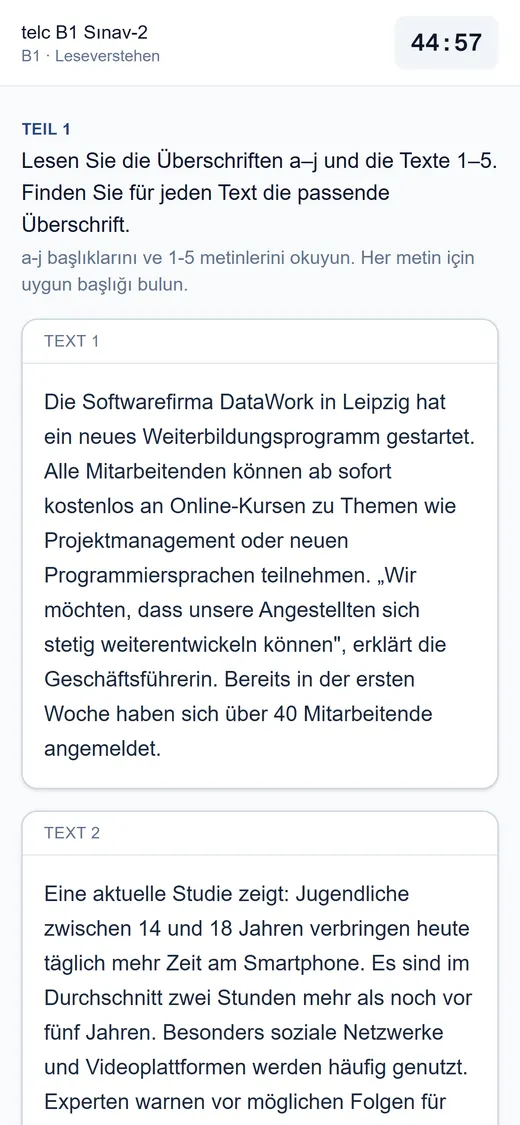
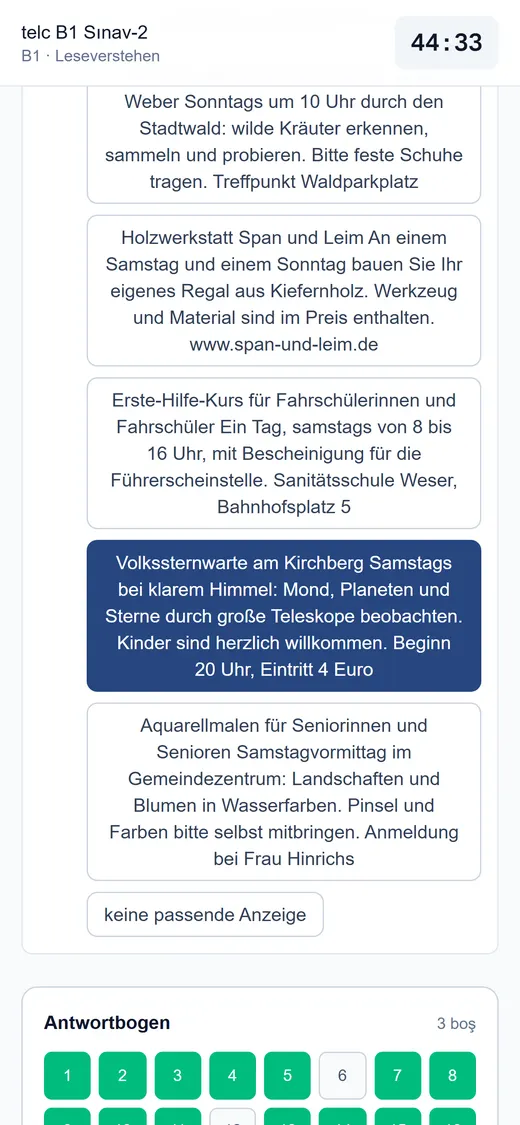
Это настоящие экраны приложения: пробный экзамен telc B1 пройден на телефоне от начала до конца, затем открыт отчёт о результатах.

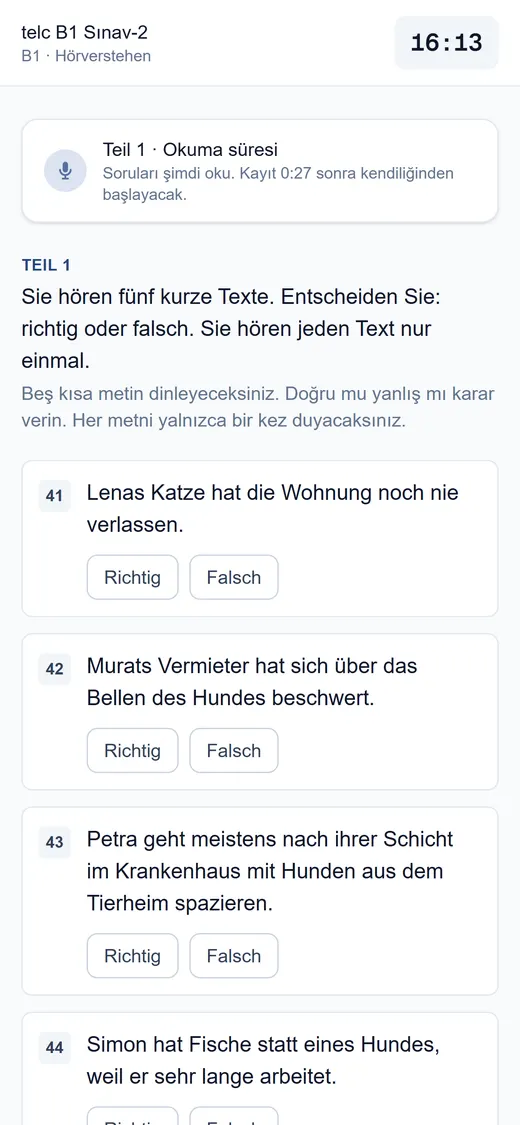
  • Чтение с таймером
    Чтение с таймеромОставшееся время части видно вверху; оно идёт на сервере, даже если вы закроете страницу.
  • Бланк ответов
    Бланк ответовОтветы заносятся в отдельный бланк, который сохраняется каждые десять секунд.
  • Аудирование
    АудированиеЗапись идёт сама: без паузы и перемотки, повторы встроены в аудио.
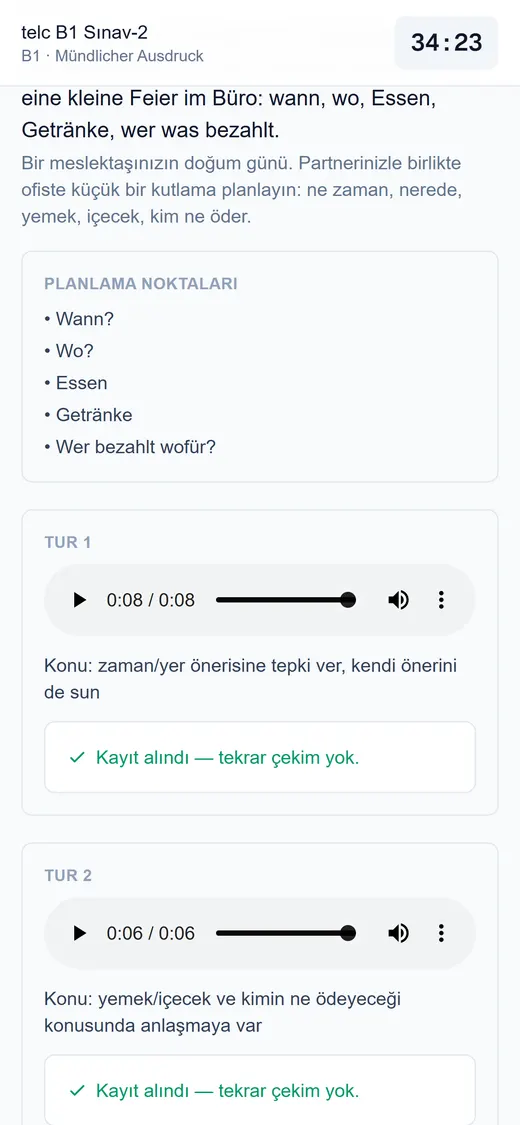
  • Устная часть
    Устная частьВаш собеседник — ИИ-партнёр; ответ записывается один раз, без повторной попытки.
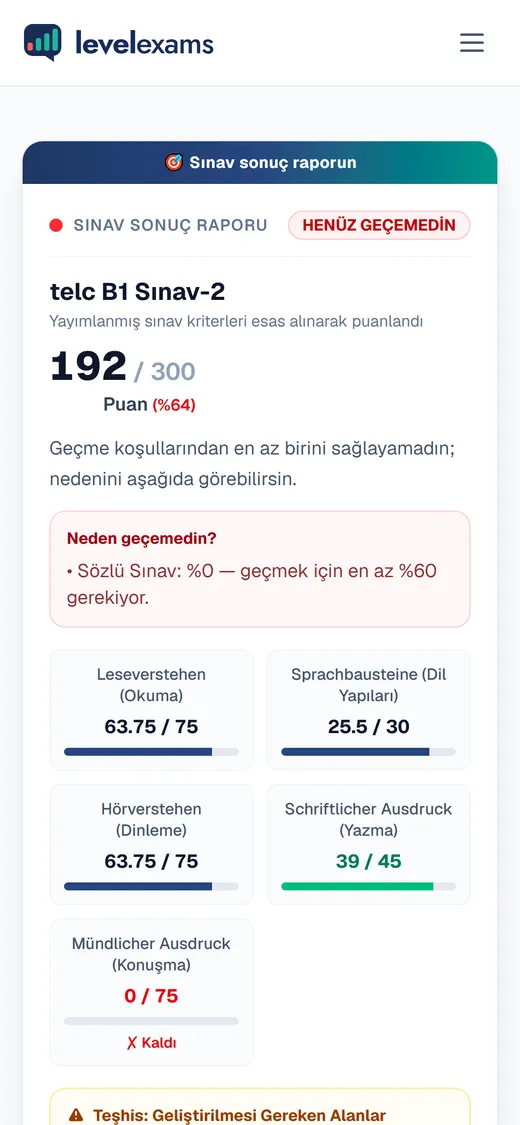
  • Отчёт о результатах
    Отчёт о результатахБаллы по каждой части, результат «сдал или не сдал» по правилу самого экзамена и ваши слабые темы.
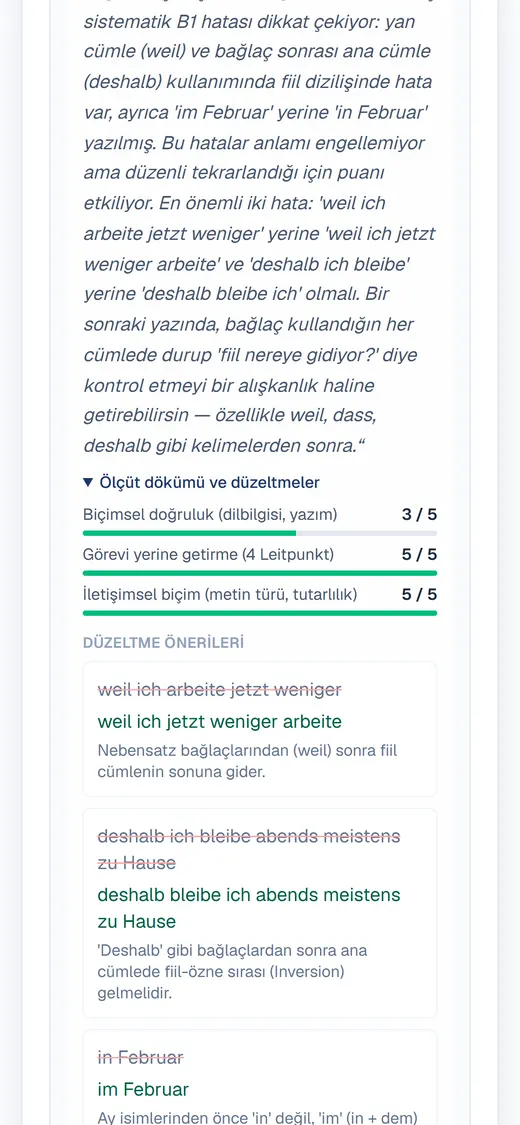
  • Обратная связь по письму
    Обратная связь по письмуИИ оценивает ваш текст по критериям этого экзамена и показывает ошибки в исправленном виде.

Экраны взяты из пробного экзамена telc B1; пробные экзамены ÖSD и Goethe используют те же экраны со своими частями и системой оценки.

Как готовиться к ÖSD C1

  1. 1

    Следите за каждым минимумом отдельно

    Если чтение, аудирование или письмо опускается ниже своего минимума, остальная часть письменного модуля не поможет. После первого полного пробника ставьте на первое место самый слабый навык.

  2. 2

    Собирайте устойчивые сочетания для пропусков в одно слово

    В пропуски последнего задания на чтение вписываются и глаголы, и существительные, и части устойчивых выражений. Записывайте сочетания вроде «zur Verfügung stellen» или «in Kauf nehmen» и внимательно пишите умлауты: a вместо ä допуск на орфографию не покрывает.

  3. 3

    Конспектируйте лекцию кратко

    Пропуски в бланке для заметок идут по ходу лекции. Прочитайте заголовки за время на чтение и во время прослушивания записывайте ключевые слова; на официальном экзамене неверная информация стоит баллов, а орфографическая ошибка — нет.

  4. 4

    В письме проверяйте объём и собственные формулировки

    В официальном ответе не переписывайте фразы из заметок; лист оценки ищет ваши собственные формулировки. В свободном тексте держитесь с запасом выше минимального объёма: поле для письма в пробнике показывает число слов.

  5. 5

    Резюмируйте раздаточные материалы, а не зачитывайте

    Перескажите своими словами главные факты из раздаточных материалов, затем добавьте своё мнение, сравнение со своей страной и личную позицию. По телефону переходите от извинения и объяснения к конкретному предложению и договаривайтесь.

Частые вопросы

›Сколько баллов нужно, чтобы сдать ÖSD C1?

Письменный и устный модули сдаются отдельно. Для письменного модуля (чтение, аудирование, письмо) нужно не меньше 42 из 70 баллов, для устного — не меньше 18 из 30. Кроме того, нужно не меньше 10 из 20 баллов по чтению, 10 из 20 по аудированию и 15 из 30 по письму; если не набрать любой из них, письменный модуль не сдан. По официальным правилам у каждого письменного задания тоже есть свой минимум.

›Сколько длится экзамен ÖSD C1?

Письменный модуль состоит из чтения (90 минут), аудирования (около 40) и письма (90); на официальном экзамене после аудирования есть перерыв. Устный модуль начинается с 20 минут подготовки, за которыми следует индивидуальный экзамен продолжительностью примерно до 20 минут. Полный пробник на Level Exams занимает около 260 минут вместе с подготовкой; между частями таймер не идёт.

›ÖSD C1 и Goethe C1 — это один и тот же экзамен?

Нет. На уровне B1 у Goethe и ÖSD общий экзамен, на уровне C1 такого партнёрства нет. В Goethe C1 каждый навык — независимый модуль, а устная часть проходит с партнёром; в ÖSD C1 письменный модуль сдаётся целиком, с минимумами внутри, а устная часть индивидуальная. На Level Exams есть пробные экзамены для обоих, и они разделены.

›Чем ÖSD C1 отличается от telc C1?

В telc C1 есть отдельная часть Sprachbausteine, у письменных частей один общий порог, а устная часть проходит в паре. В ÖSD C1 грамматика проверяется в пропусках в одно слово в чтении, у каждого письменного навыка есть минимум, а устная часть индивидуальная.

›Принимают ли ÖSD C1 для поступления в университет?

Каждый университет и программа решают это сами; общего ответа нет. В Германии для поступления чаще всего требуют языковые сертификаты TestDaF, DSH, telc C1 Hochschule и Goethe-Zertifikat C2. Если вы собираетесь поступать с ÖSD C1 — в Австрии или в Германии, — уточните языковые требования своего университета, прежде чем записываться на экзамен.

›Есть ли разные версии ÖSD C1?

Да. Помимо общего ÖSD Zertifikat C1 есть версия для молодёжи (Jugendliche) и версия PMB для профессий в сфере ухода и здравоохранения. Пробные экзамены на Level Exams моделируют общую версию; если вы записываетесь на другую, проверьте её типы заданий на сайте ÖSD.

›Где сдать экзамен ÖSD C1?

В экзаменационных центрах, лицензированных ÖSD; центры и даты указаны на osd.at. Level Exams — не экзаменационный центр и сертификатов не выдаёт; здесь вы только готовитесь.

›Где найти образец экзамена ÖSD C1 (Modellsatz)?

ÖSD бесплатно предлагает на osd.at официальный Modellsatz для общего C1 с листами заданий, решениями и записями для аудирования; листы оценки тоже есть на сайте. На бумаге следить за временем и оценивать письмо и устную речь приходится самому; на Level Exams время идёт на сервере, а письмо и устную речь оценивает ИИ. На этой странице также есть бесплатный образец ÖSD C1 в PDF от Level Exams (с листом ответов и ключом) и разобранные примеры заданий.

Узнайте, где вы относительно минимумов ÖSD C1

Регистрация бесплатна. В личном кабинете выберите тип экзамена ÖSD, затем уровень C1; пробники оценивают письменный и устный модули и минимумы по чтению, аудированию и письму отдельно, по правилам ÖSD.

Начать бесплатный пробный экзамен

Другие уровни